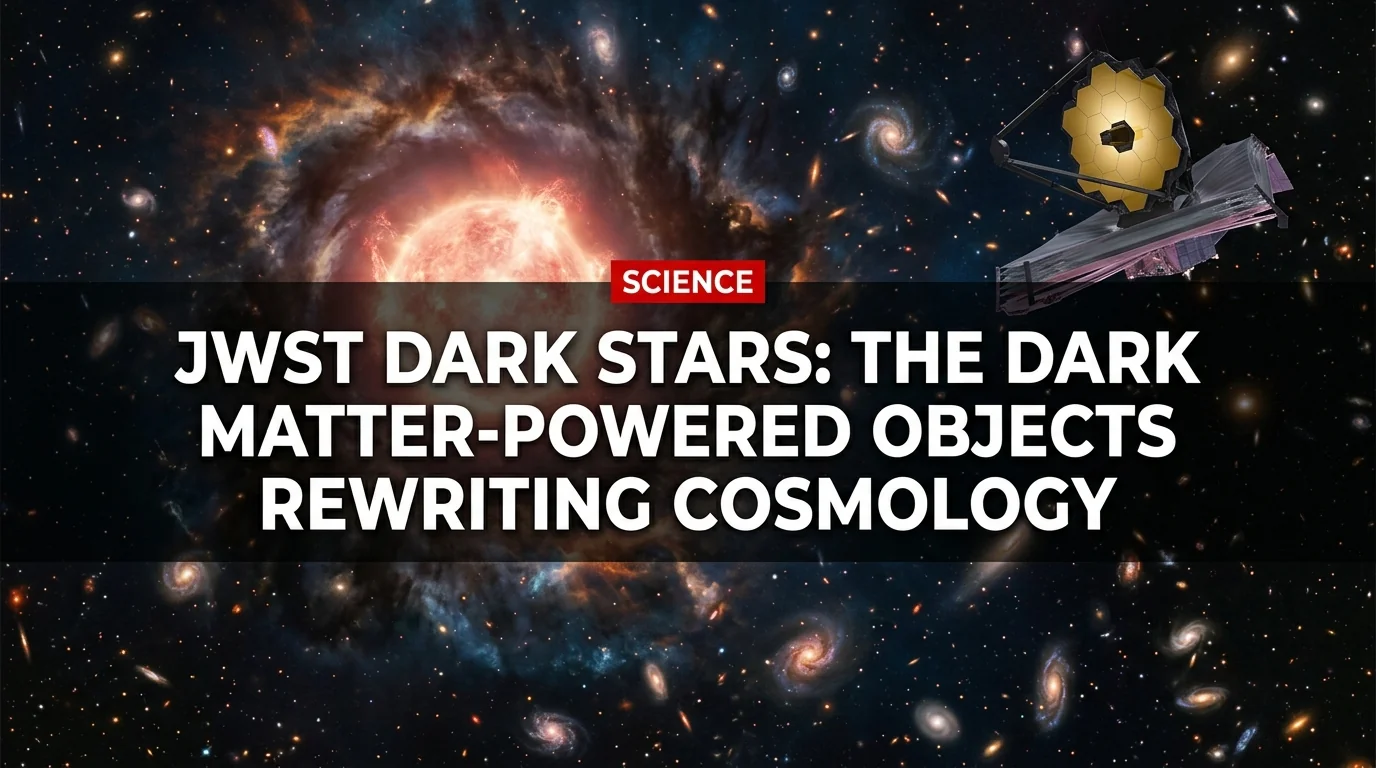
What if the earliest stars in our universe weren't powered by nuclear fusion at all — but by the annihilation of dark matter? A growing body of evidence from the James Webb Space Telescope suggests exactly that, and it could rewrite everything we thought we knew about the first 400 million years after the Big Bang.
What Are Dark Stars?
Dark stars are hypothetical first-generation stellar objects that derive their energy not from hydrogen fusion — the process that powers every star visible today — but from dark matter annihilation. First proposed in 2007 by physicists Katherine Freese, Doug Spolyar, and Paolo Gondolo, the theory remained purely speculative until JWST began peering into the earliest epochs of the universe.
- **Not actually dark** — dark stars would be among the brightest objects in the early universe
- **Powered by WIMPs** — Weakly Interacting Massive Particles annihilating in dense stellar cores
- **Massive beyond imagination** — up to 1 million solar masses, 10,000 solar radii
- **First proposed** in 2007, first candidates identified in 2023
Unlike conventional stars that burn hot and compact, dark stars would be enormous, diffuse objects — "puffy" spheres extending up to 10 astronomical units with relatively cool surface temperatures around 10,000 Kelvin.
The JWST Candidates
The JWST Advanced Deep Extragalactic Survey (JADES) has identified multiple objects that match theoretical dark star predictions. These aren't ordinary galaxies — they're point-like sources at extreme distances that don't behave the way early galaxies should.
| Candidate | Redshift | Distance (After Big Bang) | Status |
|---|---|---|---|
| JADES-GS-z14-0 | z ≈ 14 | ~320 million years | Strongest candidate — spectroscopic "smoking gun" detected |
| JADES-GS-z13-0 | z ≈ 13 | ~330 million years | Photometric candidate (2023) |
| JADES-GS-z12-0 | z ≈ 12 | ~360 million years | Photometric candidate (2023) |
| JADES-GS-z11-0 | z ≈ 11 | ~400 million years | Photometric candidate (2023) |
The most compelling evidence came from JADES-GS-z14-0, currently the second most distant luminous object ever observed. Researchers detected a telltale helium II absorption line at 1640 Ångströms — a spectral signature that dark star models specifically predict. While the signal-to-noise ratio of ~2 means it's not yet definitive, it's the closest thing to a "smoking gun" the field has produced.
Three Cosmic Mysteries, One Solution
Dark stars matter because they could simultaneously resolve three of JWST's most puzzling discoveries:
The Black Hole Seed Problem
Standard astrophysics cannot explain how billion-solar-mass black holes formed so quickly after the Big Bang. Growth from stellar-mass seeds requires more time than the universe had available. Dark stars offer an elegant bypass: when a million-solar-mass dark star exhausts its dark matter fuel, it collapses directly into a supermassive black hole — no slow accretion required.
Blue Monsters and Little Red Dots
JWST has revealed "blue monster galaxies" — objects so bright and compact in the early universe that they shouldn't exist under standard models. Proponents argue these may actually be individual supermassive dark stars, not galaxies at all. Similarly, the mysterious "Little Red Dots" — over 340 compact, red-tinted objects that emit no X-rays — could represent dark stars in the process of collapsing into black holes.
The Key Players
The dark star research program is driven by a small but determined group of scientists:
- Dr. Katherine Freese — Jeff and Gail Kodosky Endowed Chair in Physics at the University of Texas at Austin; original co-proponent of dark star theory
- Dr. Cosmin Ilie — Assistant Professor at Colgate University; lead author on the primary JWST dark star candidate studies
- Jillian Paulin — Researcher now at the University of Pennsylvania; co-author on the landmark 2023 identification paper
"Discovering a new type of star is pretty interesting... but discovering it's dark matter that's powering this — that would be huge." — Dr. Katherine Freese, University of Texas at Austin
The Skeptics Push Back
Not everyone is convinced. Dr. Daniel Whalen of the University of Portsmouth argues the research hasn't definitively differentiated dark stars from conventional Population III stars or compact clusters of primordial stars. Dr. Fabio Pacucci of Harvard's Center for Astrophysics proposes an alternative: "Black Hole Stars" — massive black holes surrounded by gas envelopes — as a more conventional explanation for the Little Red Dots.
The debate is scientifically healthy. Both camps agree on one thing: JWST is revealing an early universe far stranger than anyone predicted.
What Happens Next
Researchers are pursuing three paths to settle the debate. Higher-resolution JWST spectroscopy could confirm the helium absorption line beyond doubt. The Atacama Large Millimeter Array (ALMA) is searching for dust and heavy metals around candidates — finding them would suggest mature environments inconsistent with isolated dark stars. And Freese's team is developing automated algorithms to scan thousands of new JWST deep-field objects for dark star signatures.
The Stakes
If dark stars are confirmed, the implications extend far beyond astronomy. Their existence would constitute the first direct evidence for dark matter particle annihilation — a breakthrough that particle physicists have sought for decades using underground detectors and the Large Hadron Collider. The $10 billion JWST, designed primarily to study galaxy formation, may have stumbled onto a discovery that reshapes fundamental physics.
The early universe, it turns out, may have been far more exotic than anyone imagined — lit not by nuclear fire, but by the slow annihilation of the invisible matter that makes up 27% of everything that exists.