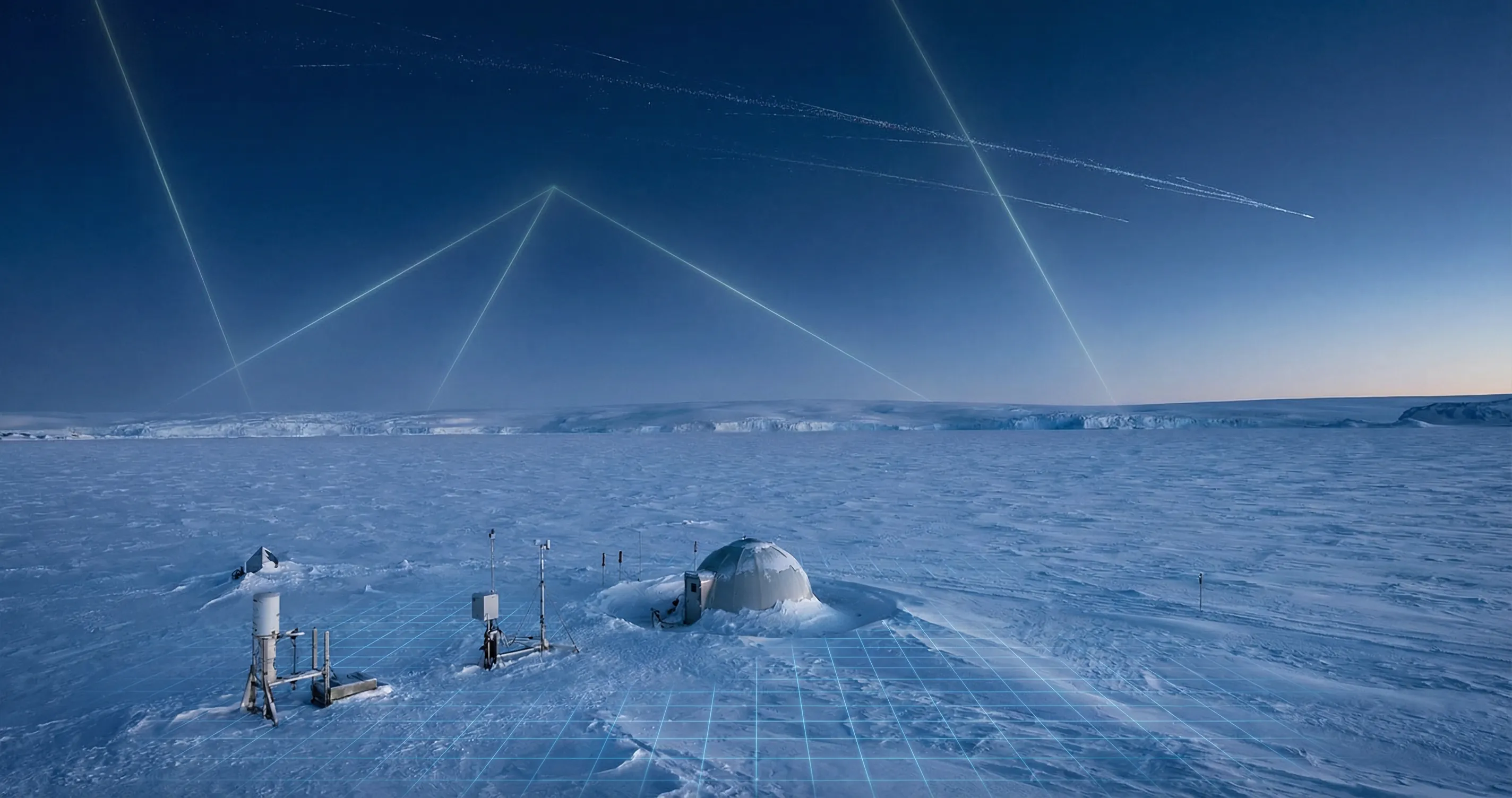
The IceCube Neutrino Observatory has used 12.6 years of data to search for neutrinos at energies far beyond what it was designed to detect. It found none, but that non-detection is enough to set the strongest limit so far on such particles and, for the first time, to constrain what fraction of the highest-energy cosmic rays are protons.
The analysis targets extremely high-energy (EHE) neutrinos—roughly above 10 PeV and up to about 100 EeV. At those energies, most neutrinos are absorbed by the Earth, so the team focused on horizontal and downward-going events to maximize the chance of a signal. A new method was used to separate possible neutrino events from the dominant cosmic-ray background by looking at stochastic clustering in the data. Results were submitted to Physical Review Letters in early 2025 and released by the IceCube collaboration in February 2025.
The Limits
The non-observation improves the previous upper limit on the EHE neutrino flux by a factor of two. At 1 EeV, the all-flavor neutrino flux is constrained to below about 10^-8 GeV cm^-2 s^-1 sr^-1. That closes a chunk of the possible "new energy window on the universe" that theorists had speculated could be opened by EHE neutrinos.
Link to Cosmic Rays
Ultra-high-energy cosmic rays (UHECRs) have been observed for over a century, but their composition and sources are still debated. If a large fraction of UHECRs are protons, they should produce EHE neutrinos when they interact with radiation in space. IceCube's limit on EHE neutrinos can therefore limit how many of the highest-energy cosmic rays can be protons. Under the assumption that UHECR sources evolve like the star formation rate, the analysis restricts the proton fraction above 30 EeV to less than about 70%—the first such constraint from neutrino data alone.
This approach avoids some of the uncertainties in hadronic interaction models that affect traditional cosmic-ray experiments.
What's Next
IceCube and future neutrino telescopes will keep pushing to higher energies and longer exposures. Tighter neutrino limits will further narrow the allowed composition and source models for UHECRs, and any eventual detection would open a new channel for studying the most energetic processes in the universe.