DESI Cosmic Map Challenges Einstein With Dark Energy Shift
The DESI 3D cosmic map of 18.7 million galaxies suggests dark energy may be weakening, challenging Einstein's cosmological constant and standard physics.
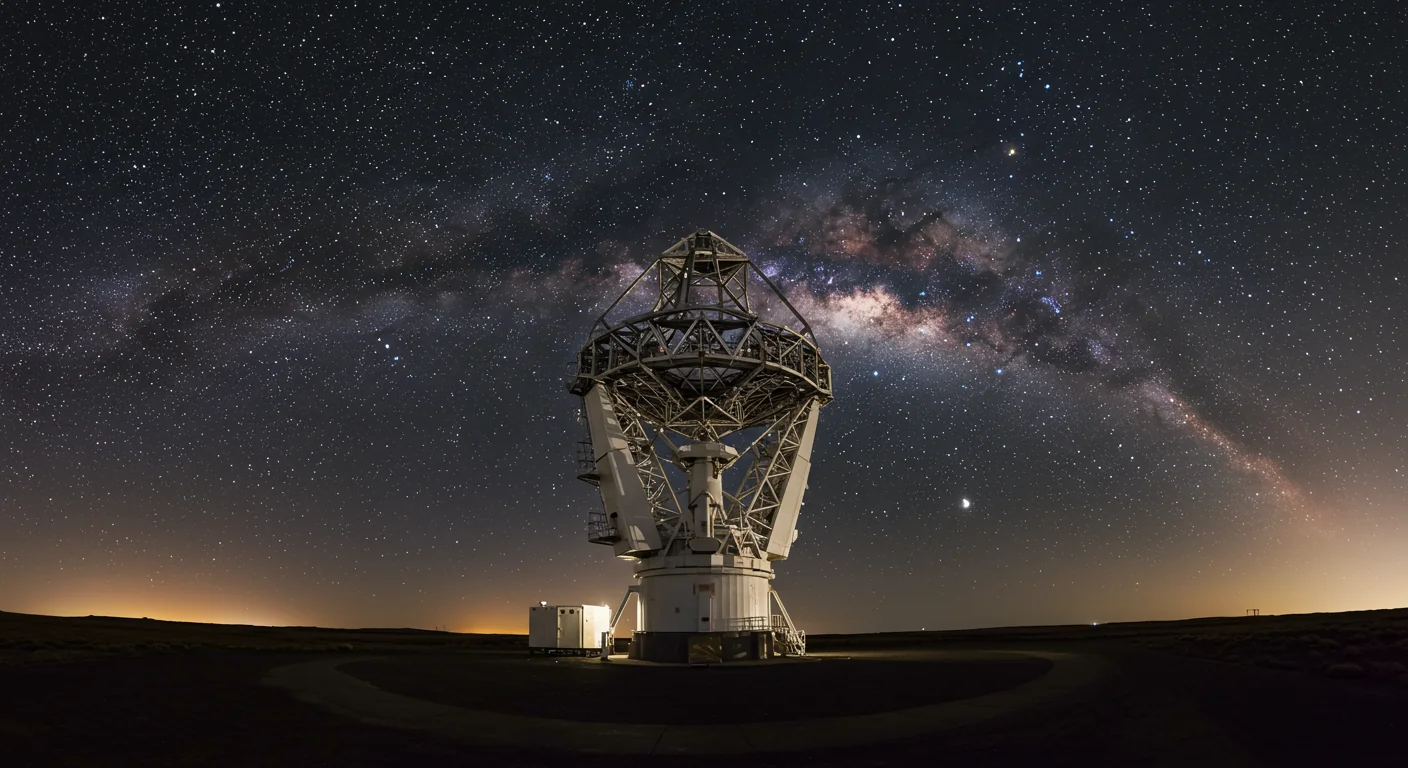
The largest three-dimensional map of the universe ever assembled is forcing physicists to reconsider a foundational assumption about the cosmos: that dark energy, the mysterious force accelerating expansion, behaves as a constant.
The Dark Energy Spectroscopic Instrument collaboration, working from a mountaintop telescope in Arizona, has now catalogued 18.7 million celestial objects stretching back 11 billion years. Their data, released in stages since April 2024 and culminating in a landmark March 2025 analysis, points to something Albert Einstein's equations did not predict. Dark energy appears to be changing over time.
Background
For a quarter century, the Lambda-CDM model has served as cosmology's standard framework. It treats dark energy as a cosmological constant, a fixed value Einstein introduced to his field equations in 1917 and later called his "greatest blunder." The model has withstood every major observational test, from the cosmic microwave background measured by the Planck satellite to galaxy surveys conducted by the Sloan Digital Sky Survey over more than a decade.
DESI was built to stress-test that framework with unprecedented precision. Mounted on the Nicholas U. Mayall 4-meter Telescope at Kitt Peak National Observatory, the instrument deploys 5,000 robotic fiber positioners that reconfigure every 20 minutes, capturing spectra from roughly 100,000 galaxies per night. Construction cost $75 million, finishing $1.9 million under budget.
Key Details
The collaboration's Year-3 results, drawn from 15 million galaxies and quasars, achieved 0.5 percent precision in measuring the expansion history of the universe. For the period between eight and 11 billion years ago, precision exceeded one percent, a threshold no prior survey had reached.
When combined with data from the Planck satellite and Type Ia supernovae observations, the measurements favor a model where dark energy strengthens and then weakens over cosmic time. The statistical significance ranges between 2.8 and 4.2 sigma depending on the dataset combination, short of the five-sigma threshold physicists require to claim discovery but strong enough to demand attention.
"We're seeing some potentially interesting differences that could indicate that dark energy is evolving with time," said Michael Levi, DESI director at Lawrence Berkeley National Laboratory.
The collaboration spans more than 900 researchers across 70 institutions worldwide, with Lawrence Berkeley National Laboratory managing the project and the National Energy Research Scientific Computing Center processing the 270 terabytes of data contained in the first public release alone.
Impact
If dark energy is indeed weakening, the consequences reach far beyond academic journals. The standard prediction for the universe's fate, an eternal cold expansion known as heat death, would need revision. A weakening dark energy could allow gravity to eventually dominate again, potentially leading to a contraction.
Carlos Frenk, a professor at Durham University and veteran cosmologist, described the findings as revealing "chinks in the armor" of the standard model, suggesting the field may be approaching a fundamental rethinking of cosmic physics.
Not all physicists are convinced the signal is real. Andrew Pontzen of University College London has urged "a healthy grain of salt," noting that statistical anomalies often dissolve with additional data. Critics have pointed to a troubling feature of the best-fit models: they imply a negative neutrino mass, a physical impossibility that could indicate a systematic error rather than new physics.
Mustatpha Ishak-Boushaki, a professor at the University of Texas at Dallas who leads analysis on gravity and dark energy within the collaboration, has acknowledged the tension. Resolving it will require the full five-year dataset.
What's Next
DESI's primary survey is wrapping up, with the complete five-year observations expected to yield 40 to 50 million redshift measurements. That final dataset will either strengthen the evolving dark energy signal past the discovery threshold or reduce it to a statistical fluctuation.
The answer will not come from DESI alone. The European Space Agency's Euclid mission, launched in July 2023, is conducting its own dark energy survey from orbit. The Vera C. Rubin Observatory in Chile, expected to begin full operations soon, will add ground-based observations at a scale comparable to DESI. Cross-verification between all three programs should settle the question within the next two to three years.
The collaboration was awarded the 2026 Lancelot M. Berkeley Prize for their mapping work, recognition that regardless of whether the dark energy signal holds, the instrument has already reshaped how astronomers measure the universe.
Gina Rameika, associate director for high energy physics at the U.S. Department of Energy, called the results "the most precise measurement of our expanding universe." Whether that precision reveals genuinely new physics or confirms the old framework with greater confidence, the map itself stands as the most detailed census of cosmic structure ever completed.
Tags
Sources
- https://newscenter.lbl.gov/2025/03/19/new-desi-results-strengthen-hints-that-dark-energy-may-evolve/
- https://www.eurekalert.org/news-releases/1077516
- https://www.desi.lbl.gov/
- https://news.utdallas.edu/science-technology/desi-findings-2024/
- https://www.earth.com/news/largest-ever-3d-map-of-the-universe-lets-us-travel-back-11-billion-years/
- https://newscenter.lbl.gov/2024/04/04/desi-first-results-make-most-precise-measurement-of-expanding-universe/
- https://noirlab.edu/public/news/noirlab2512/
- https://www.sci.news/astronomy/desi-expanding-universe-3d-map-12831.html
Related Articles
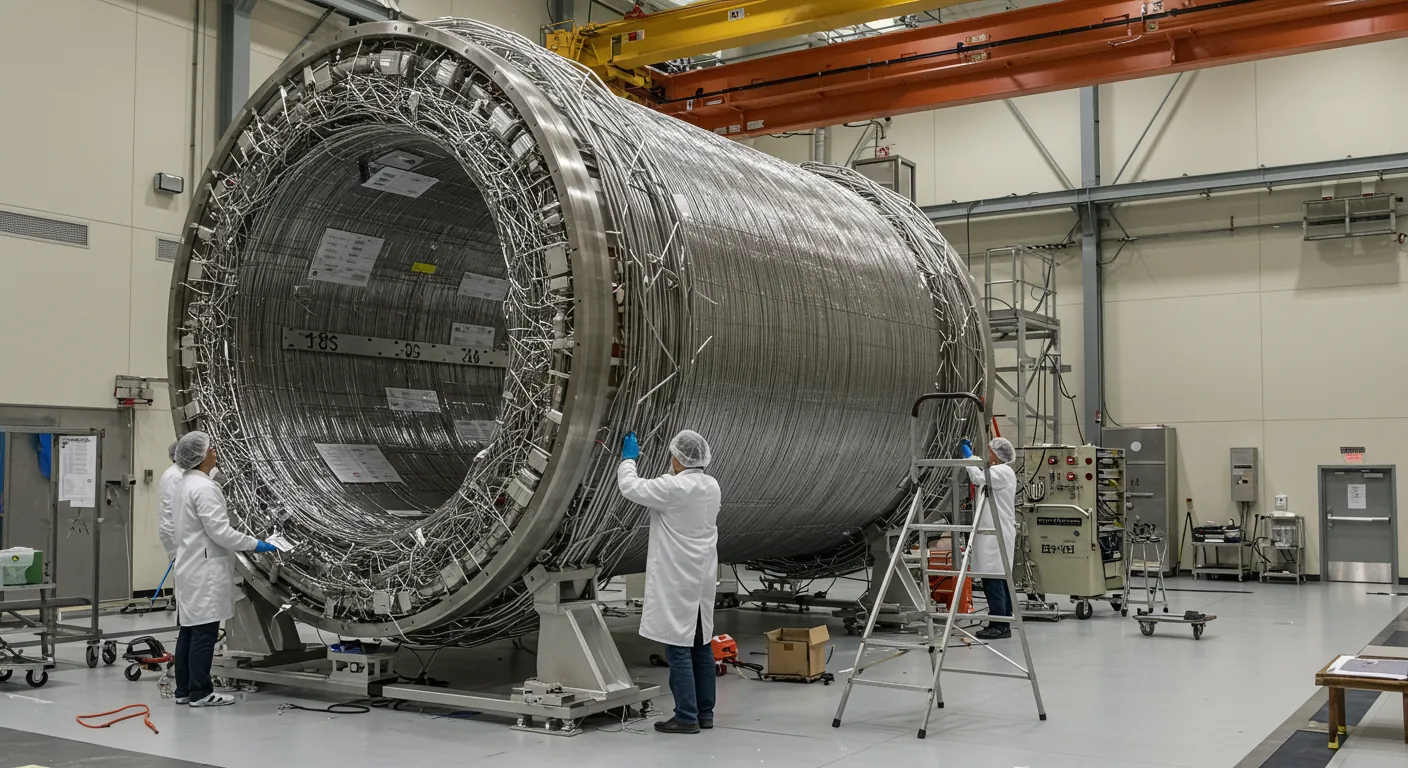
Commonwealth Fusion Systems Installs First SPARC Magnets Ahead of 2026 Plasma Target
Commonwealth Fusion Systems has installed the first toroidal field magnets on its SPARC reactor in Massachusetts, advancing toward first plasma by late 2026.
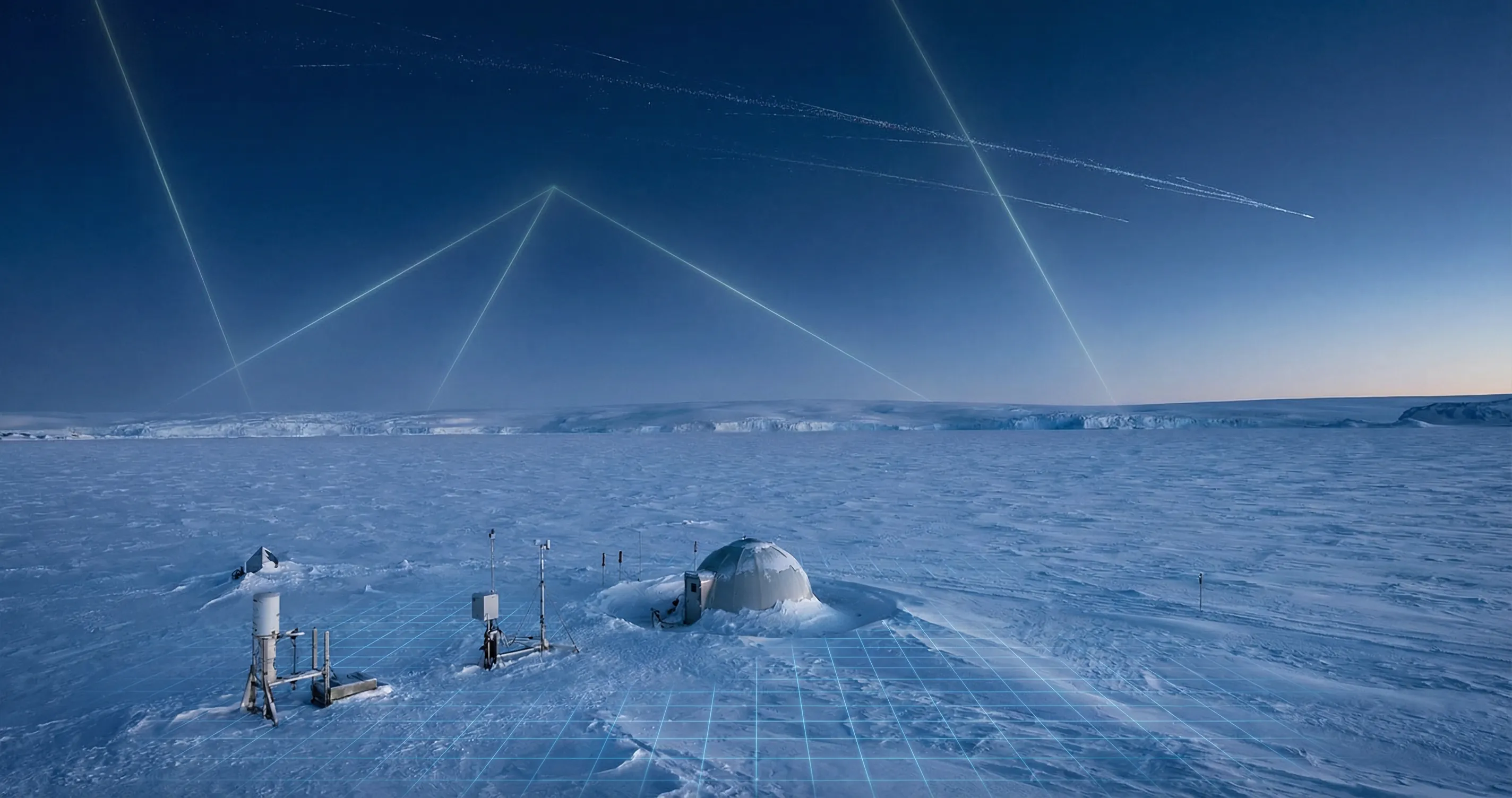
IceCube Search for Extremely High-Energy Neutrinos Narrows Cosmic Ray Mystery
Using 12.6 years of data, IceCube set the tightest limit yet on neutrinos above 10 PeV and used it to constrain the proton fraction in ultra-high-energy cosmic rays for the first time.

Hydrogen From Bioethanol at 270°C With Zero Direct CO2 Emissions
A new catalyst turns ethanol into hydrogen and acetic acid at 270°C with no direct CO2 release. The process can meet U.S. green hydrogen rules and has been run 100+ hours continuously.