
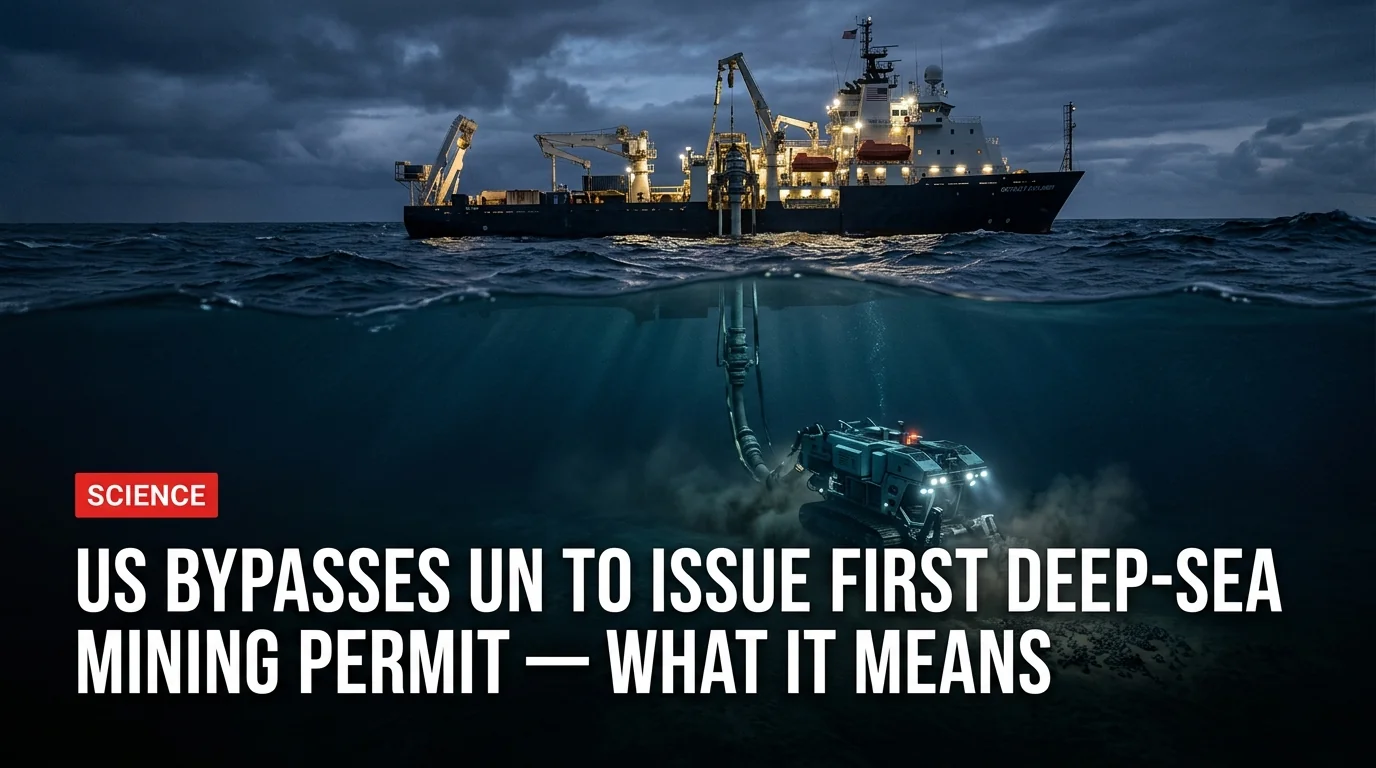
The ocean floor just became the world's newest geopolitical battleground. On March 9, 2026, the United States granted the first-ever commercial deep-sea mining permit — not through the United Nations body designed to regulate it, but through its own domestic agency, NOAA.
The decision has triggered a jurisdictional crisis between Washington and the International Seabed Authority (ISA), the UN-mandated regulator for international waters. Ten days later, the ISA's 30th Council Session in Kingston, Jamaica ended in stalemate — no Mining Code, no framework, and a blunt warning from Secretary-General Leticia Carvalho that America's move "risks the fragmentation of ocean governance."
What Happened
NOAA approved a consolidated application from The Metals Company (TMC), a Vancouver-based firm, to both explore and commercially recover polymetallic nodules from the Clarion-Clipperton Zone (CCZ) — a vast abyssal plain between Hawaii and Mexico.
The key distinction: the ISA has issued 29 exploration contracts over the years. No one — until now — has received a path to actual extraction. And this permit didn't come from the ISA at all.
Why the US Can Do This
The United States has never ratified the UN Convention on the Law of the Sea (UNCLOS), which established the ISA and declared the international seabed the "Common Heritage of Humankind." Instead, the US operates under the Deep Seabed Hard Mineral Resources Act (DSHMRA) of 1980 — a domestic law that predates the ISA entirely.
NOAA Administrator Neil Jacobs framed the decision in economic terms: "This consolidation supports the America First agenda by enabling U.S. companies to access these resources more quickly, strengthening our nation's economic resilience."
What's at Stake on the Ocean Floor
The Clarion-Clipperton Zone contains potato-sized rocks called polymetallic nodules, rich in minerals critical to the energy transition.
These nodules contain nickel, cobalt, copper, and manganese — metals that currently come from terrestrial mines with their own environmental and human rights problems. TMC argues that collecting nodules from the seafloor is less destructive than strip-mining on land.
Critics say we simply don't know enough about deep-sea ecosystems to make that call.
The Battle Lines
- ISA has failed to deliver a Mining Code after a decade of talks
- Critical minerals are needed for EV batteries and clean energy
- US domestic law provides a "stable, transparent" regulatory path
- Seafloor collection may be less destructive than land mining
- Deep-sea ecosystems are poorly understood and potentially irreplaceable
- Unilateral action violates the "Common Heritage of Humankind" principle
- No environmental impact assessment has been independently verified
- Could set a precedent for unchecked ocean resource grabs
Sofia Tsenikli of the Deep Sea Conservation Coalition called the US approach "reckless," warning it "risks sacrificing the ocean for short-term commercial interests." Meanwhile, TMC CEO Gerard Barron accused the ISA of being "in breach of its express treaty obligations" by failing to produce regulations.
The Global Race Is On
The US isn't the only country eyeing the deep sea. India made headlines in September 2025 by signing a 15-year ISA contract to explore the Carlsberg Ridge in the Indian Ocean — becoming the first nation with two separate ISA contracts for polymetallic sulphides.
But there's a crucial difference: every other nation is working within the ISA system. The US is the first to go around it entirely.
What Happens Next
Three things to watch:
July 2026 — The ISA reconvenes to attempt finalizing the Mining Code. If they fail again, expect more countries to consider the unilateral route.
Legal challenge — Experts anticipate a case before the International Tribunal for the Law of the Sea (ITLOS). The Africa Group and small island developing states are likely to lead it.
TMC operations — The company plans test recovery operations by late 2026, with full-scale commercial mining targeted for 2027. If nodules start coming up from the Pacific floor, the legal and environmental debate becomes moot in a very real way.
- The US issued the first commercial deep-sea mining permit on March 9, 2026 through NOAA — bypassing the UN's International Seabed Authority
- The ISA's 30th Council Session ended March 19 without finalizing the Mining Code needed for its own permits
- The Metals Company plans to mine 65,000 km² of the Clarion-Clipperton Zone for nickel, cobalt, and manganese
- Legal challenges are expected at the International Tribunal for the Law of the Sea
- The decision tests whether one nation can claim resources from the "Common Heritage of Humankind"
The deep sea was supposed to be humanity's shared inheritance. Whether it becomes a regulated commons or a first-come-first-served free-for-all may depend on what happens in the next six months.