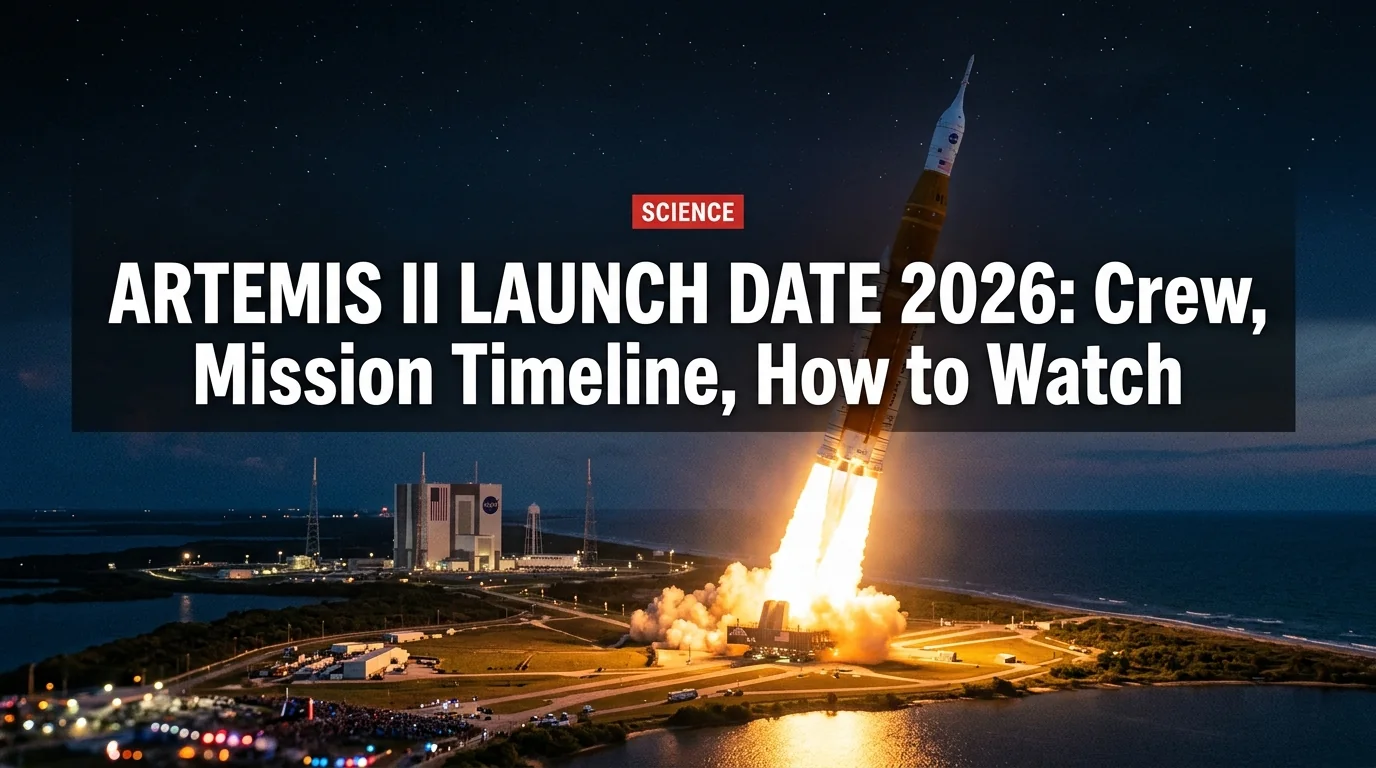
NASA's Artemis II mission is days away from launching four astronauts on humanity's first trip to the Moon since 1972. The crew is in quarantine, the rocket is on the pad, and the countdown clock is ticking toward a historic April 1 liftoff.
This is the complete guide to everything you need to know.
- **Launch date:** April 1, 2026 at 6:24 PM EDT (22:24 UTC)
- **Launch site:** Pad 39B, Kennedy Space Center, Florida
- **Mission duration:** 10 days, 1 hour, 42 minutes
- **Farthest point:** 400,171 km from Earth — a new human record
- **Splashdown:** Pacific Ocean, off the coast of San Diego
Meet the Artemis II Crew
Four astronauts will strap into the Orion capsule on April 1. Together, they represent a historic first: the most diverse deep-space crew ever assembled.
| Astronaut | Role | Agency | Notable First |
|---|---|---|---|
| G. Reid Wiseman | Commander | NASA | Former Chief of the Astronaut Office |
| Victor J. Glover Jr. | Pilot | NASA | First person of color on a lunar mission |
| Christina Koch | Mission Specialist | NASA | First woman on a lunar mission |
| Jeremy Hansen | Mission Specialist | CSA | First non-American on a lunar mission |
Backup crew members Andre Douglas (NASA) and Jenni Gibbons (CSA) have trained alongside the primary four and are ready to step in if needed. The crew entered quarantine on March 18 to ensure they're healthy for launch.
The 10-Day Mission, Day by Day
Artemis II won't land on the Moon — that's Artemis III. Instead, this is a critical shakedown cruise: fly Orion around the Moon with humans aboard for the first time and bring them home safely.
The skip reentry is particularly important. During Artemis I in 2022, the uncrewed Orion's heat shield lost more material than expected. NASA has since modified the reentry trajectory to reduce stress on the thermal protection system.
The Rocket: SLS by the Numbers
The Space Launch System is the most powerful rocket ever built. Its core stage, built by Boeing, is powered by four RS-25 engines — the same design that flew on the Space Shuttle, upgraded for deep-space performance. Two solid rocket boosters from Northrop Grumman provide the majority of thrust during the first two minutes of flight.
The Orion spacecraft sitting on top was built by Lockheed Martin, with its service module — providing power, propulsion, air, and water — built by Airbus for the European Space Agency.
Who Built What
| Component | Contractor | Role |
|---|---|---|
| SLS Core Stage | Boeing | Main rocket body + engines |
| Solid Rocket Boosters | Northrop Grumman | 75% of launch thrust |
| RS-25 Engines | Aerojet Rocketdyne | Four core-stage engines |
| Orion Capsule | Lockheed Martin | Crew module + heat shield |
| European Service Module | Airbus / ESA | Power, propulsion, life support |
The Cost Question
Artemis is not cheap. And that's been a persistent source of criticism.
Figures in billions of USD. Sources: NASA OIG, GAO-25-10710.
At an estimated $4.1 billion per launch, each SLS flight costs roughly what NASA spent on an entire year of Space Shuttle operations. The Government Accountability Office flagged $6.8 billion in combined cost overruns across SLS, Orion, and ground systems in a July 2025 report.
- First crewed deep-space mission in 53 years
- Tests critical systems for future Moon landings
- Most diverse crew in spaceflight history
- Validates Orion heat shield with humans aboard
- Strengthens international partnerships (CSA, ESA)
- $4.1 billion per-launch cost vs. SpaceX Starship at ~$100M
- Heat shield concerns remain after Artemis I anomaly
- No lunar landing — that waits for Artemis III/IV
- Program is years behind original schedule
- Inspector General questions long-term sustainability
The Heat Shield Debate
The elephant in the room: during Artemis I, Orion's heat shield charred unevenly, losing more ablative material than models predicted. NASA spent two years investigating.
NASA's solution: modify the reentry trajectory. Instead of a direct plunge, Orion will use the skip reentry technique to reduce peak heating. Administrator Jared Isaacman stated the agency has "full confidence in the Orion spacecraft and its heat shield, grounded in rigorous analysis."
The crew has accepted the risk. The question is whether the data from this flight will validate NASA's models — or force a redesign before Artemis III.
How to Watch the Launch
Online (free):
- NASA TV and nasa.gov/live — full mission coverage starting hours before launch
- Space.com live stream
- YouTube: NASA's official channel
In person (Florida Space Coast):
- Kennedy Space Center Visitor Complex — launch viewing packages are sold out
- Public beaches — Cape Canaveral and Cocoa Beach offer direct sightline to Pad 39B. Arrive 4+ hours early; traffic will be extreme
- Watch parties — Space Center Houston is hosting a launch day event with NASA commentary
What Comes Next
If Artemis II succeeds, the next steps accelerate:
- Artemis III — First crewed lunar landing since 1972, using SpaceX Starship as the lander
- Artemis IV — First mission to the Lunar Gateway space station
- Long-term goal — Sustainable human presence on and around the Moon by the 2030s
But everything hinges on the next 10 days. If Orion's heat shield performs, if the life support holds, if four humans can safely travel farther from Earth than any person in history — then the Moon is back in business.
The countdown is at T-minus 9 days.