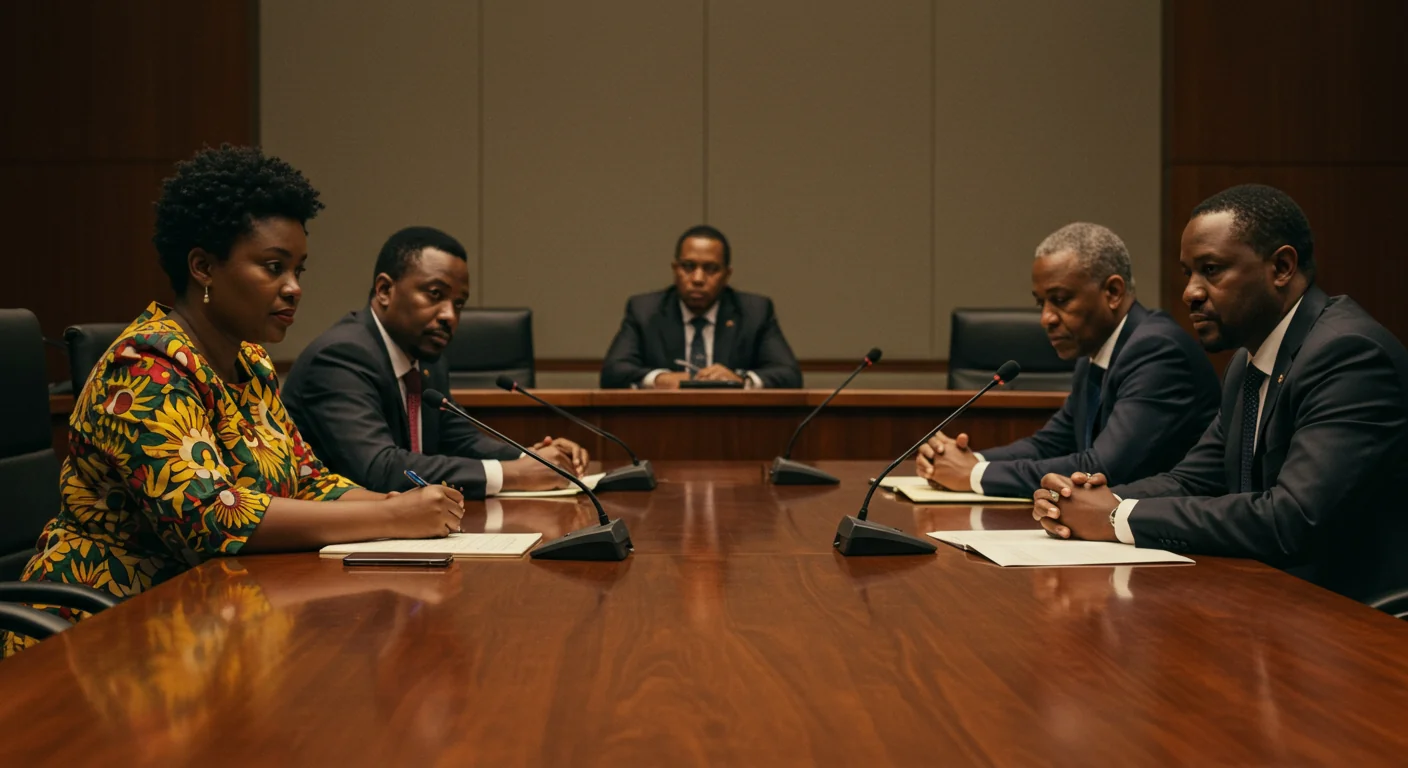
South Africa's grand experiment in coalition governance is fracturing. The Government of National Unity (GNU), born from the African National Congress's historic loss of its parliamentary majority in May 2024, now faces its gravest threat as the country hurtles toward local government elections later this year.
The question is no longer whether the coalition is in trouble — it's whether it can survive 2026 at all.
The Numbers Behind the Crisis
These aren't just statistics. They represent the pressure cooker that every coalition argument plays out inside. When unemployment sits at 32% and youth joblessness exceeds 54%, political disagreements aren't academic — they're existential.
How the Coalition Broke Down
The July 2025 dismissal of Andrew Whitfield proved to be the turning point. When President Cyril Ramaphosa removed the DA's Deputy Minister of Trade and Industry, DA leader John Steenhuisen didn't just protest — he pulled his party out of the National Dialogue entirely.
"The president cannot even dialogue meaningfully with his own coalition partners," Steenhuisen said at the time. "There is little point in pretending there is substance to an ANC-run national dialogue."
That breach has never fully healed.
The Battleground Map
With local government elections scheduled between November 2, 2026 and January 31, 2027, three regions will determine whether South Africa's coalition model survives or fractures into chaos.
- ANC projected below 20% (analyst Sandile Swana)
- Helen Zille running for Mayor on DA ticket
- Service delivery collapse driving voter rage
- Multiple mayors in short succession since 2021
- MK Party (Jacob Zuma) lobbying to break provincial coalition
- ANC-DA alliance under direct attack
- Zuma's populist appeal strongest here
- Provincial government described as "under siege"
Gauteng, home to Johannesburg and Ekurhuleni, presents perhaps the starkest picture. Premier Panyaza Lesufi has admitted the province is "trapped" in a cycle of decline, with unemployment hitting 34.4% — well above the national average.
The Power Players
Five figures will shape what happens next:
Cyril Ramaphosa (ANC President) walks a tightrope between keeping the DA in the tent and fending off attacks from his left. His party's decline from liberation movement to 40% coalition partner has been humbling, and the MK Party — led by his predecessor — smells blood.
John Steenhuisen (DA Leader, Agriculture Minister) must decide whether governing alongside the ANC helps or hurts the DA's brand heading into elections. His withdrawal from the National Dialogue suggests he's leaning toward confrontation.
Helen Zille (DA Federal Council Chair) has returned to frontline politics with a Johannesburg mayoral bid. Her candidacy is a direct challenge to ANC governance in South Africa's economic capital.
Jacob Zuma (MK Party Leader) leads the most disruptive force in South African politics. His party captured 14% of the national vote in 2024 and is now actively working to dismantle ANC-DA coalitions at the provincial level.
Julius Malema (EFF Leader) sits outside the GNU nationally but participates in provincial "marriages of convenience" in Gauteng, adding another layer of unpredictability.
The Economic Squeeze
The economic picture makes coalition politics nearly impossible. With GDP growth hovering around 1%, there's no surplus to distribute — only scarcity to fight over. The ANC wants expansionary social spending. The DA wants fiscal discipline and market reforms. These positions are fundamentally incompatible when the economy isn't growing.
Gauteng's provincial government is seeking R800 billion ($43 billion) in investment pledges by 2028 to arrest its economic decline — an ambitious target given the political uncertainty driving investors away.
The Legal Vacuum
Perhaps the most dangerous element of South Africa's coalition era is the absence of rules governing it. There is no formal legislation regulating how coalitions form, operate, or dissolve. Analysts have called this a "legal vacuum" that enables the constant churn of leadership seen in cities like Johannesburg, where multiple mayors have come and gone since 2021.
Parliament is debating the Local Government: Municipal Structures Amendment Bill, which would limit motions of no confidence to once every two years. But the bill hasn't passed yet, and without it, the coming elections could produce dozens of ungovernable municipalities.
- Coalition Bill would stabilize municipal governance
- Limits political churn from constant no-confidence votes
- Gives elected mayors time to actually implement policy
- Critics say it protects incompetent leaders from accountability
- Still stuck in parliamentary debate with no passage date
- Doesn't address fundamental ideological rifts in the GNU
What Happens Next
The voter registration weekend of June 20-21, 2026 will serve as the first real gauge of public sentiment. If turnout surges — particularly among young voters — it could signal a dramatic reshuffling of power at the local level.
The GNU's survival may ultimately depend on a paradox: neither the ANC nor the DA wants to be blamed for its collapse, yet both parties need to distance themselves from each other to win votes. That tension — between governing together and campaigning apart — may be irreconcilable.
As Oxford Economics noted, the GNU is "a year older, none the wiser." South Africa's democracy has survived apartheid, one-party dominance, and state capture. Whether it can survive coalition politics remains an open question — and 2026 will provide the answer.
KEY STAT: The 2024 election ended 30 years of ANC majority rule. The 2026 local elections will determine whether coalition governance is South Africa's future — or its next crisis.