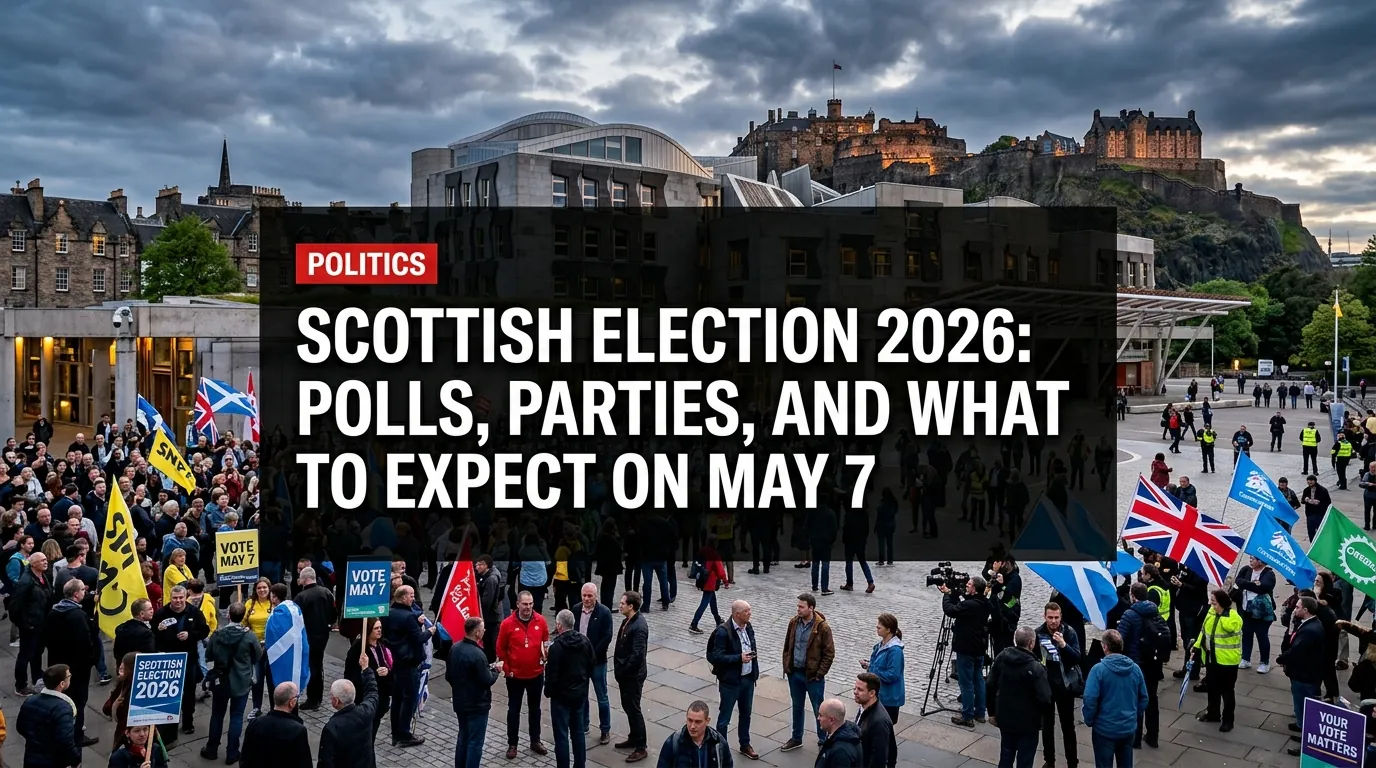
Scotland heads to the polls on May 7 in what analysts call the most unpredictable Holyrood election since devolution began in 1999. A record 39 MSPs are retiring, boundary maps have been redrawn, and a Westminster scandal is dragging Scottish Labour into crisis mode — all while Reform UK prepares to storm a parliament it has never set foot in.
The Numbers That Matter
Where the Polls Stand
Multiple pollsters paint a consistent picture: the SNP leads, but a majority is far from guaranteed. Reform UK has surged from irrelevance to serious contender in under two years.
| Party | Constituency % | Regional List % | Projected Seats | 2021 Result |
|---|---|---|---|---|
| SNP | 34–37% | 26–33% | 57–67 | 64 |
| Reform UK | 16–20% | 14–20% | 15–25 | 0 |
| Scottish Labour | 18% | 16% | 17–18 | 22 |
| Conservatives | 11% | 12% | 12–13 | 31 |
| Scottish Greens | 6% | 8% | 7–9 | 7 |
| Lib Dems | 7% | 6% | 5–7 | 4 |
KEY STAT: Reform UK polled at 0.2% of the list vote in 2021. They now project 15–25 seats — potentially the largest debut by any party in Holyrood history.
The SNP needs 65 seats for a majority. Most projections put them between 57 and 67, meaning John Swinney likely needs the Greens to govern — or pulls off a narrow majority through tactical voting.
Five Storylines Driving This Election
1. The Mandelson Bomb Under Scottish Labour
Anas Sarwar's Labour campaign was already struggling to differentiate from Westminster when the Peter Mandelson scandal detonated. The sequence:
Sarwar's break with Starmer was dramatic but may have come too late. Scottish Labour MPs privately fear the Mandelson affair is "resonating on the doorsteps" in ways that local messaging cannot overcome.
2. Reform UK's Holyrood Invasion
Lord Malcolm Offord, a businessman turned politician, leads Reform UK Scotland with a simple pitch: Scotland is "underperforming" and needs an "anti-establishment alternative." The Additional Member System — designed to give smaller parties representation through regional lists — is perfectly suited to Reform's broad-but-shallow support base.
Projections range from 15 to 25 seats, all through the regional list. They are unlikely to win a single constituency. But even 15 seats would make them a major opposition force and fundamentally change Holyrood's dynamics.
3. The SNP's Renewal Gamble
John Swinney inherited a party battered by the Sturgeon-era finance scandal and a leadership crisis. His pitch — "renewal" after 19 years in power — asks voters to believe the same party can be both the establishment and the change agent.
Professor John Curtice, Scotland's foremost polling analyst, notes the SNP is "currently still heading for significant losses" even as it leads every poll. The question is not whether they finish first, but whether they cross 65 seats.
4. The Conservative Collapse
Russell Findlay took over Scottish Conservative leadership in September 2024 with the party polling around 20%. It now sits at 11–12%. The hemorrhaging is almost entirely toward Reform UK, and the new boundary map — which altered 45 constituencies — has scrambled whatever incumbency advantage Tory MSPs once held.
Projected to drop from 31 seats to roughly 12, the Conservatives face their worst Scottish result since devolution.
5. Alba's Death and the Independence Vote
The Alba Party, founded by Alex Salmond in 2021, formally de-registered on March 8 after leader Kenny MacAskill cited "perilous financial position" and "financial irregularities." Salmond's death in 2024 had already gutted the party's raison d'être. The practical effect: a small but meaningful pool of independence-first voters returns to the SNP or stays home.
The Boundary Shake-Up
Boundaries Scotland redrew the electoral map for the first time since 2010. The changes are extensive:
- **45 of 73** constituencies altered (names, boundaries, or both)
- **3** constituencies changed name only
- **28** constituencies unchanged
- **Only 1 region** (Mid Scotland and Fife) completely untouched
- **3 protected island seats** exempt from review: Na h-Eileanan an Iar, Orkney, Shetland
For voters, this means checking whether their constituency has changed. For parties, it means incumbency data from 2021 is largely unreliable — adding another layer of unpredictability.
Key Dates
| Date | Event |
|---|---|
| March 16 | Notice of Election published |
| March 20 | Candidate registration deadline; short campaign begins |
| April 9 | Parliament dissolves |
| April 20 | Voter registration deadline |
| April 21 | Postal vote application deadline (5:00 PM) |
| May 7 | Polling day (7:00 AM – 10:00 PM) |
| May 8 | Counting begins 9:00 AM; results by late afternoon |
What Happens After May 8
If no party reaches 65 seats — the most likely scenario — coalition talks begin immediately. The two plausible governing arrangements:
SNP + Greens: The most likely outcome. If the SNP lands 57–62 seats, the Greens' projected 7–9 seats could push them past the majority threshold. This would continue the power-sharing model that governed Scotland from 2021 to 2023.
Unionist bloc: A Labour-Conservative-Lib Dem arrangement is arithmetically possible but politically toxic. Sarwar has ruled out formal coalition with the Tories, making this a last resort.
The wildcard: if the SNP hits 65+ seats, Swinney governs alone — and the independence question returns to center stage with renewed democratic legitimacy.
The Bottom Line
This election will reshape Scottish politics regardless of who wins. Reform UK enters Holyrood for the first time. The Conservatives may lose more than half their seats. Labour is fighting a UK scandal instead of a Scottish campaign. And the SNP is trying to convince voters that 19 years in power is not enough.
The only certainty: May 8 will deliver a parliament that looks nothing like the one Scotland has now.