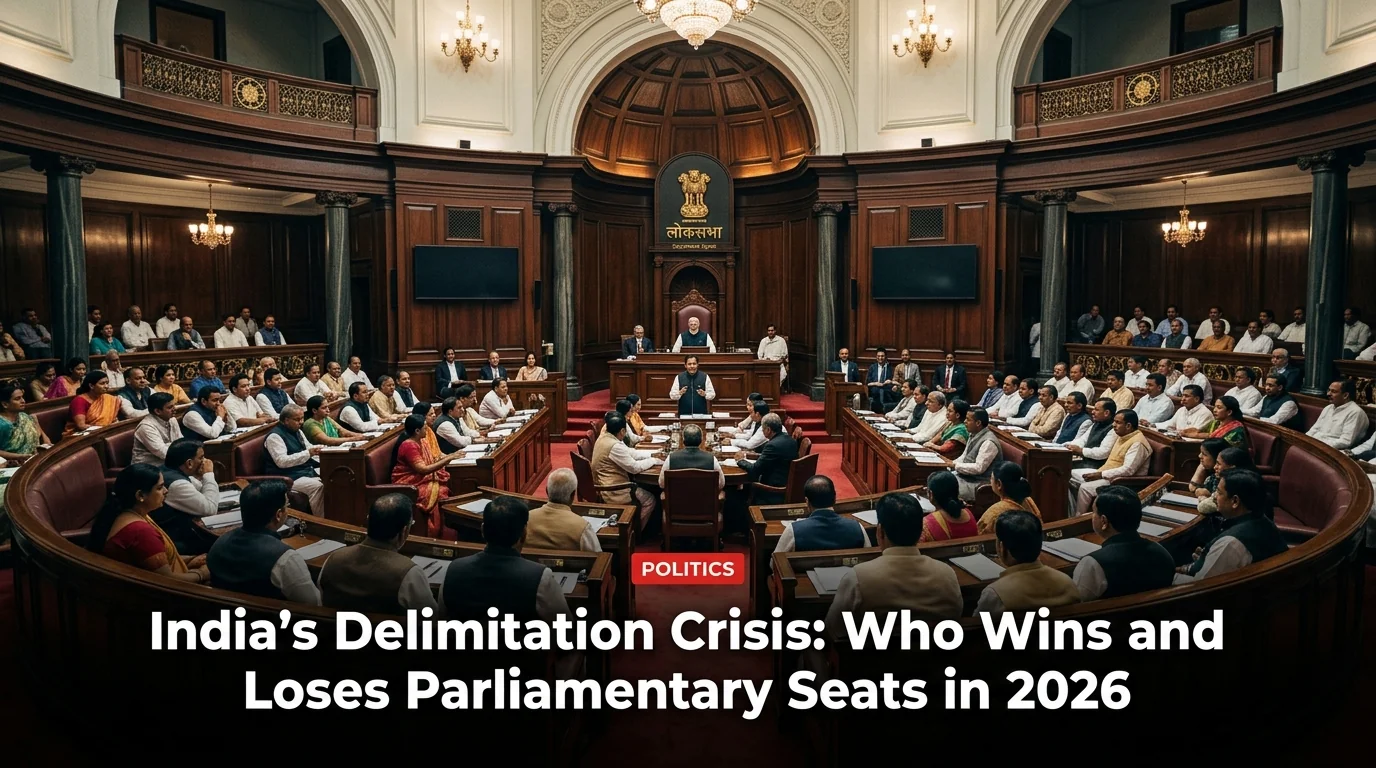
India is heading into its most consequential constitutional reshaping since independence. The freeze on Lok Sabha seat allocation — locked since the 1971 Census — expires this year, triggering a redistribution that could fundamentally alter the balance of power between India's booming northern states and its economically dominant south.
The stakes are existential for Indian federalism. States that controlled their populations face losing political influence, while states that didn't stand to gain enormous power in Parliament.
- **50 years frozen** — Parliamentary seats have been locked to 1971 Census data since the 42nd Amendment
- **543 → 848 seats** — Lok Sabha could expand by 56% to maintain proportional representation
- **April 1, 2026** — Census houselisting operations officially begin
- **2029 election** — First general election likely to use the redrawn map
Why This Is Happening Now
In 1976, Prime Minister Indira Gandhi's government froze parliamentary seat allocation to the 1971 Census through the 42nd Constitutional Amendment. The goal: ensure states that implemented aggressive population control wouldn't be punished with fewer seats in Parliament.
The 84th Amendment in 2001 extended that freeze until 2026. That deadline has now arrived, and there's no consensus on what comes next.
The Census 2027 — India's first digital census — begins its houselisting phase on April 1, 2026, with full population enumeration scheduled for February 2027. Once that data is in, the Delimitation Commission will have the constitutional mandate to redraw every constituency in the country.
The North-South Divide: By the Numbers
The core problem is arithmetic. Southern states slowed their population growth; northern states didn't. Pure population-based redistribution rewards the latter.
| State | Current Seats | Projected Seats | Change |
|---|---|---|---|
| Uttar Pradesh | 80 | 143 | +63 |
| Bihar | 40 | 79 | +39 |
| Rajasthan | 25 | 31 | +6 |
| Tamil Nadu | 39 | 41 | +2 |
| Kerala | 20 | 19–20 | 0 to −1 |
| Karnataka | 28 | 26 | −2 |
| Andhra Pradesh + Telangana | 42 | 34 | −8 |
The implications are staggering. Under a purely population-based model, the Hindi-speaking heartland could approach a two-thirds supermajority in the Lok Sabha — enough to amend the Constitution without support from any other region.
The Southern Revolt
Southern chief ministers aren't taking this quietly.
Tamil Nadu's M.K. Stalin has been the most vocal, forming a Joint Action Committee (JAC) of opposition-led states in March 2025. His framing is sharp: "States which fulfilled their national duties by controlling population will face an unjust punishment."
Karnataka's Siddaramaiah called delimitation "a weapon to silence the South."
The JAC — which includes Tamil Nadu, Kerala, Telangana, and Punjab — is lobbying for a 25-year extension of the seat freeze, pushing the reckoning to 2051.
The Government's Balancing Act
Union Home Minister Amit Shah has tried to calm nerves, stating that "no southern state will lose seats." The strategy appears to be expanding the total house size rather than redistributing existing seats — so northern states gain while southern states hold steady.
The new Parliament building, inaugurated in May 2023, was designed with 888 Lok Sabha seats and 384 Rajya Sabha seats — a clear signal that expansion was always the plan.
The 16th Finance Commission, chaired by Arvind Panagariya, also laid groundwork in its February 2026 report by adding new fiscal devolution criteria:
| Criteria | Weight | Purpose |
|---|---|---|
| Population (2011) | 15% | Democratic representation |
| Area | 15% | Geographic needs |
| Forest & Ecology | 10% | Environmental factors |
| Income Distance | 40% | Equalizing poorer states |
| Contribution to GDP | 10% | Rewards economic performers |
| Demographic Performance | 10% | Rewards population control |
The last two criteria are new — a clear concession to southern states that generate outsized economic value and controlled their fertility rates.
What Happens Next
A constitutional amendment requires a two-thirds majority in both houses of Parliament — which means the ruling BJP-led coalition needs broad support. That gives southern parties significant leverage in negotiations, despite their smaller numbers.
The Deeper Question
India's delimitation crisis exposes a tension that every large democracy faces but few confront this directly: should political power follow population, or should it account for economic contribution and governance outcomes?
The European Parliament uses digressive proportionality — smaller states get more seats per capita than larger ones. Germany uses weighted voting in its upper house. India's founders chose a simpler model, then froze it for half a century when reality got complicated.
That freeze is over. How India resolves this will define its federal character for the next generation.
KEY STAT: Southern states produce 35% of India's GDP with under 20% of its population — the economic engine being asked to accept less political power.
The census starts in 11 days. The clock is ticking.