France has formally extended its nuclear deterrent to cover Polish territory, completing a bilateral defense pact that reshapes Europe's security architecture at a moment when Washington's commitment to the continent remains uncertain.
The agreement, known as the Kraków Accord, reached full strategic implementation this month after ratification summits in Poland's second city. President Emmanuel Macron announced the "Forward Deterrence" scheme on March 2 at the Île Longue submarine base in Brittany, naming Poland as a core nuclear-sharing partner.
Background
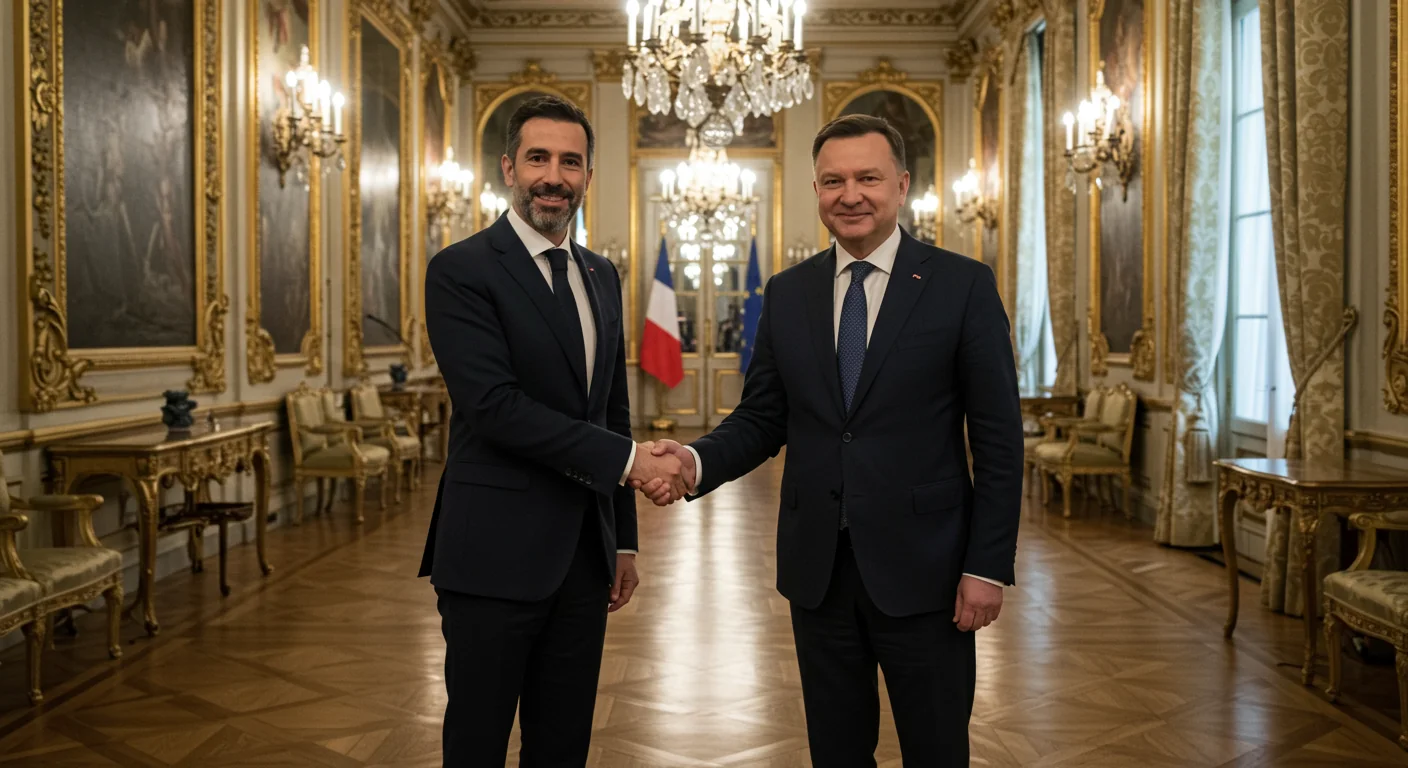
The treaty's origins trace to December 2023, when Prime Minister Donald Tusk took office and moved to repair Franco-Polish relations damaged during eight years of Law and Justice (PiS) rule. By March 2025, Tusk and Macron had finalized a draft text. The formal signing took place on May 9, 2025, in Nancy — a city chosen for its historical ties to Polish King Stanisław I Leszczyński.
The document's official name is the Treaty on Strengthened Cooperation and Friendship. Its core clause pledges mutual defense "including by military means" in the event of armed aggression on either nation's territory. It is the first time France has offered such a guarantee, paired with nuclear coverage, to a non-neighboring state.
Analysts at Chatham House describe the accord as Poland's deliberate move to diversify its security commitments beyond the United States. Poland's defense spending now stands at 4.8 percent of GDP, the highest in NATO, and its active military of 216,000 troops surpasses France's 205,000.
Key Details
The treaty operates across four pillars: mutual defense, industrial integration, intelligence sharing, and nuclear deterrence.
On the industrial side, Poland is finalizing purchases of Airbus A330 MRTT tanker aircraft. Naval Group is negotiating the Orka submarine program to modernize Poland's aging fleet. MBDA leads the European Long Range Strike Approach missile program, which both countries now jointly fund.
The nuclear component is the most consequential. France maintains 290 warheads and has committed to integrating Polish "vital interests" into its strategic doctrine. Polish pilots will begin dual-capable aircraft interoperability training with French Rafale units. Strategic air assets will rotate through Polish bases for joint exercises.
A joint ammunition production line will supply both nations' stockpiles and continue feeding materiel to Ukraine. Collaboration on quantum computing, artificial intelligence, and satellite intelligence is written into the treaty's technology annex.
Impact
The accord effectively creates a Paris-Warsaw axis that runs parallel to the Franco-German relationship at the heart of the European Union. It elevates Poland to a tier of French allies previously reserved for Germany, Italy, and Spain.
The geopolitical context is stark. American foreign policy has shifted toward disengagement from European security commitments. European leaders have responded by accelerating plans for strategic autonomy. The Kraków Accord is the most concrete expression of that shift.
Moscow reacted sharply. Vladimir Putin characterized the extension of the French nuclear umbrella as a provocation. Within France, Marine Le Pen's Rassemblement National criticized what it called a "dispersal" of French nuclear sovereignty.
German Chancellor Friedrich Merz has been involved in parallel Weimar Triangle consultations, signaling Berlin's awareness that the Franco-Polish axis cannot function in isolation from Germany. The European Commission is monitoring the Security Assistance for Europe initiative, which would unlock EU-backed loans for joint defense projects.
What's Next
The treaty's implementation schedule runs through 2027. French strategic air units will begin rotational deployments to Polish airbases in the coming months. The joint ammunition production facility is expected to reach operational capacity by late 2026.
Poland's Council of Ministers adopted the Advanced Nuclear Deterrence agenda in February. The operational details — troop transit corridors, communications integration, targeting protocols — were finalized during the March summits in Kraków.
The broader question is whether other European nations will seek similar arrangements. The Baltic states and Finland have expressed interest in the French nuclear umbrella concept. Macron has spoken of maintaining a "European dimension" to France's arsenal, language that leaves room for further expansion.
For now, the Kraków Accord stands as Europe's answer to a question it has spent decades avoiding: what happens when the continent must guarantee its own security.