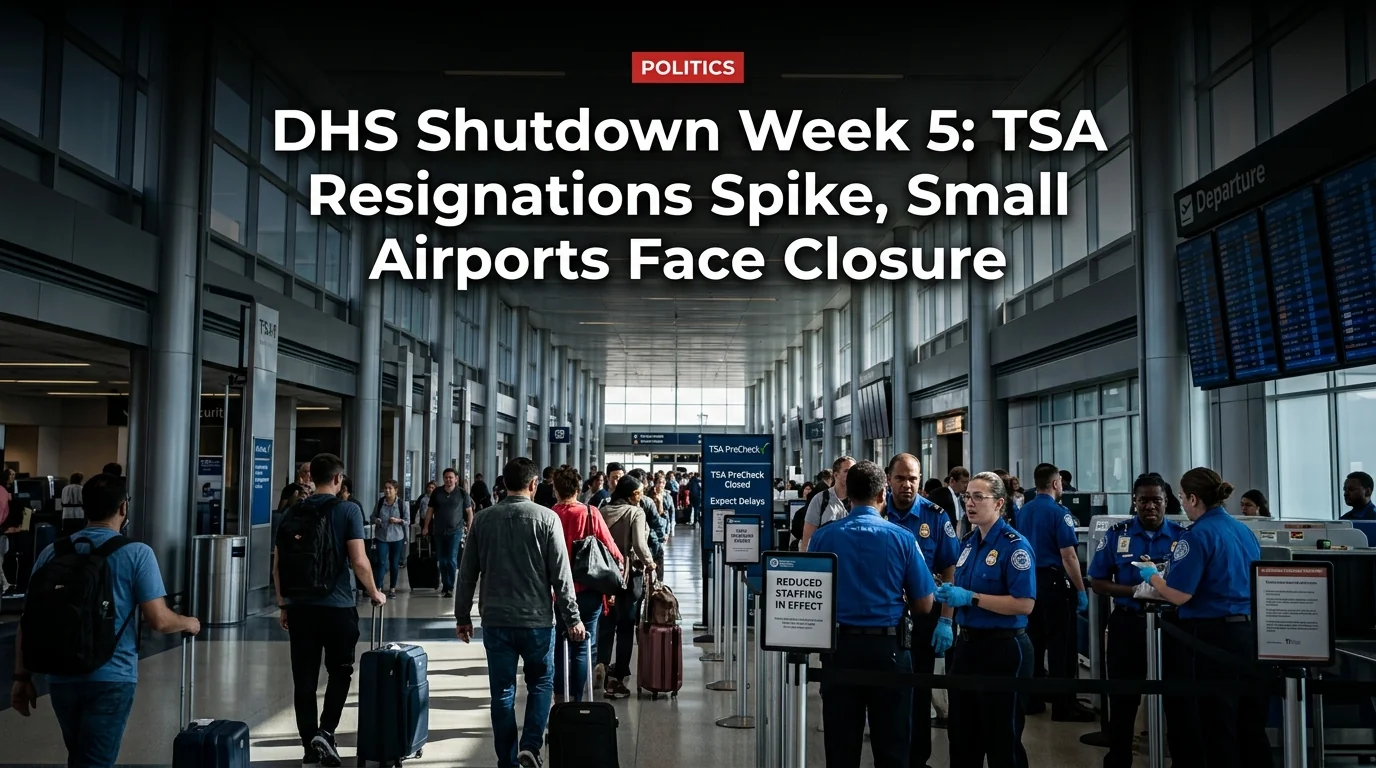
The partial shutdown of the U.S. Department of Homeland Security has entered its fifth week with no resolution in sight, and the consequences are no longer theoretical — they are showing up at airport security lines across the country.
Since DHS funding lapsed on February 14, 2026, 366 TSA officers have resigned, call-out rates have spiked by 12% nationwide, and security wait times at major airports have blown past the 90-minute mark. Acting Deputy TSA Administrator Adam Stahl has warned that if the trend continues, some smaller airports may be forced to shut down entirely.
- **DHS has been unfunded since February 14, 2026** — now 33 days and counting
- **366 TSA officers** have officially resigned over missed paychecks
- **50,000+ TSA workers** are currently working without pay
- **90+ minute** security wait times at Atlanta and O'Hare airports
- **11 of 12** appropriations bills were passed on March 13 — DHS was the exception
How We Got Here
The current crisis is not about money in the traditional sense. Congress cleared 11 of 12 annual spending bills on March 13, averting a total government shutdown. But the twelfth — DHS funding — remains stuck in a political standoff over immigration enforcement accountability.
The catalyst was the January 24 killing of Alex Pretti and Renee Good by Customs and Border Protection agents during an operation in Minneapolis. Their deaths prompted Senate Democrats to withdraw support for the pending DHS funding bill, demanding strict accountability measures for CBP before approving any new money.
The Airport Crisis, By the Numbers
The human cost of the shutdown is concentrated at the nation's airports, where TSA officers — classified as "excepted" essential workers — are required to show up but receive no paycheck.
The crisis is hitting during spring break — one of the busiest travel periods of the year. Airline CEOs have issued a joint letter to Congress calling the situation "simply unacceptable" and warning of potential flight delays and cancellations.
| Airport | Call-Out Rate | Peak Wait Time | Status |
|---|---|---|---|
| Houston (IAH/HOU) | 50%+ | 100+ min | Critical |
| Atlanta (ATL) | 30%+ | 100+ min | Critical |
| New Orleans (MSY) | 30%+ | 80+ min | Severe |
| New York (JFK) | Elevated | 60+ min | Strained |
| Seattle (SEA) | Elevated | 45+ min | Strained |
| Boston (BOS) | Elevated | 45+ min | Strained |
DHS has suspended all courtesy and special privilege escorts at airports — including those for members of Congress — to redirect officers to essential security screening. Global Entry enrollment has been halted, with CBP officers reassigned to process arriving travelers.
The $60 Billion Question
The disputed DHS funding amounts to roughly $60 billion in discretionary authority. But the fight is not really about the dollar figure — it is about policy riders attached to the spending.
Senate Minority Leader Chuck Schumer has framed it as a matter of principle: "We cannot in good conscience fund an agency that operates without oversight after the tragedies in Minnesota."
The White House, through a senior official, has characterized its March 17 counteroffer as "a good faith attempt to try to come to a reasonable and expeditious conclusion," placing blame on Democrats for not reciprocating.
KEY STAT: The DHS shutdown is the third time in less than six months that 50,000 TSA officers have worked without pay. The October–November 2025 shutdown lasted a record 43 days.
What Keeps DHS Running Despite the Shutdown
Not all of DHS is dark. The One Big Beautiful Bill Act (OBBBA), passed in 2025, provided $170 billion in mandatory and multi-year funding for certain immigration activities. That is why ICE and CBP remain operational even without new appropriations — their funding comes from a separate, already-enacted source.
This creates an unusual situation: the enforcement agencies at the center of the political controversy continue operating, while the workers who screen airline passengers go unpaid.
What Happens Next
Three developments could break the impasse:
New DHS Secretary confirmation — Markwayne Mullin, nominated to replace the dismissed Kristi Noem, is expected to be confirmed by late March. A new leader could provide political cover for a deal.
April 15 budget deadline — Congress faces a statutory deadline to pass a FY2027 budget resolution. Leaving FY2026 DHS funding unresolved while starting FY2027 negotiations would be politically untenable.
Escalating public pressure — If small airports begin closing, the political calculus shifts dramatically. Voters in rural districts will feel the shutdown directly.
The Committee for a Responsible Federal Budget has warned that "Continuing Resolution fatigue" is causing lasting damage to federal recruitment and retention — a problem that will persist long after the shutdown ends.
For now, the 50,000 TSA workers screening bags and checking IDs at America's airports will continue showing up — unpaid, understaffed, and uncertain when the standoff will end.
This is a developing story. Last updated March 19, 2026, 11:00 PM UTC.