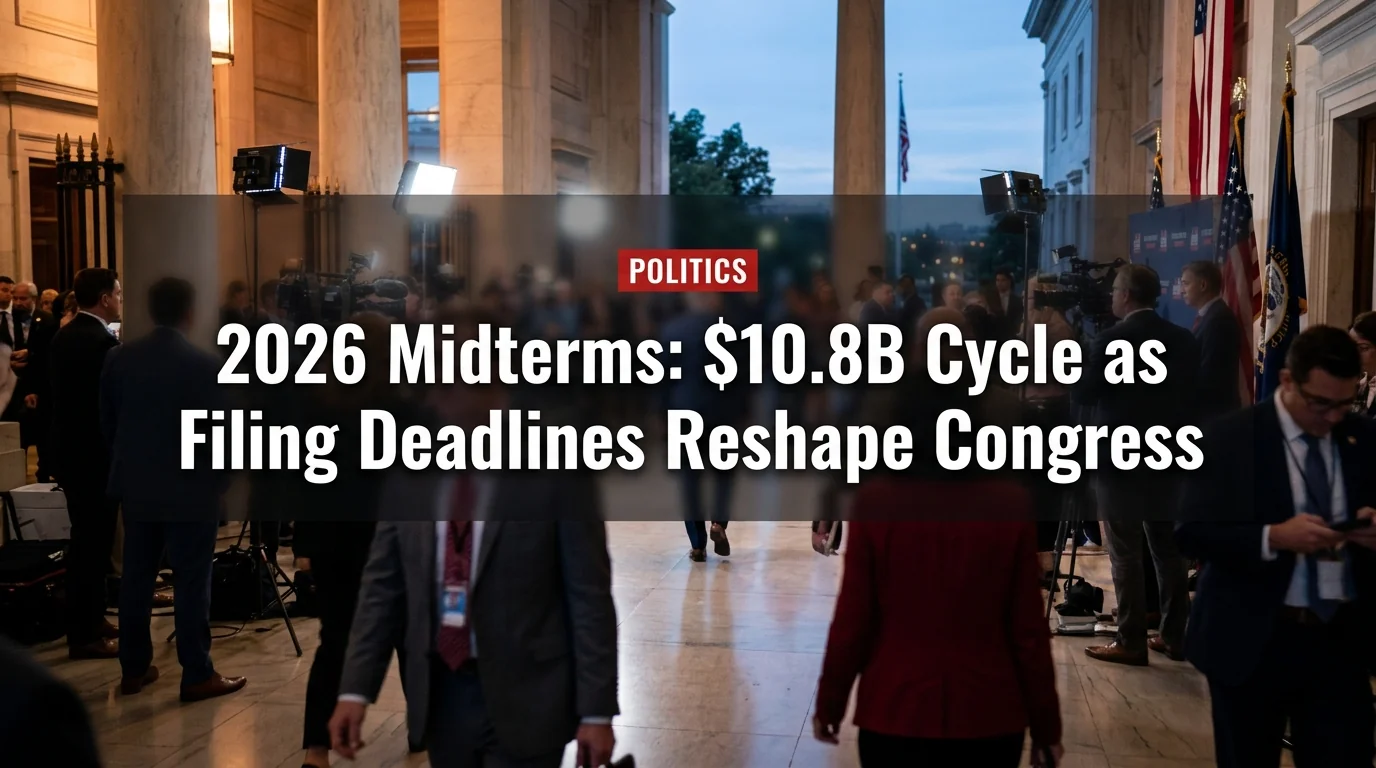
The 2026 U.S. midterm election cycle is officially the most expensive non-presidential campaign season ever recorded. With $10.8 billion in projected total ad spending — a 20% surge over 2022 — and filing deadlines now closed in a dozen states, the battle for Congress is fully underway.
All 435 House seats and 35 Senate seats (33 regular, 2 special elections) are in play. Here's what you need to know.
Where the Money Is Going
The sheer scale of spending has already shattered records before summer. The Texas Republican Senate primary between incumbent John Cornyn and challenger Ken Paxton burned through $128 million — making it the most expensive Senate primary in American history. Cornyn, who raised over $70 million, now heads to a May 26 runoff.
NRSC Chair Tim Scott has predicted that at least two Senate races will individually exceed $1 billion by November.
The Races That Will Decide the Senate
Republicans are defending 22 seats to Democrats' 13, giving Democrats their clearest path to a Senate majority since 2020. Seven states will determine control:
| State | Republican | Democrat | Projected Spend | Status |
|---|---|---|---|---|
| North Carolina | Michael Whatley | Roy Cooper | ~$1B | General election |
| Maine | Susan Collins | TBD | ~$600M | Filing open |
| Georgia | TBD | Jon Ossoff (inc.) | $400M+ | Filing open |
| Texas | Cornyn vs. Paxton | James Talarico | $300M+ | GOP runoff May 26 |
| Ohio | TBD | TBD | $250M+ | Special election |
| Michigan | TBD | TBD | $200M+ | Filing open |
| Alaska | TBD | TBD | $150M+ | Filing open |
The North Carolina showdown between former Governor Roy Cooper (D) and ex-RNC Chair Michael Whatley (R) is the marquee race. Cooper has already raised $18 million; Whatley trails at $5 million but expects massive Super PAC support.
Filing Deadline Tracker
Filing deadlines determine who's on the ballot. Several major states have already closed, while others remain open through summer.
Filing fees vary wildly. Florida charges the highest at $10,440, while New Hampshire asks just $2 for state house candidates.
Early Primary Results: What They Tell Us
Three states have already voted. The results reveal a competitive, volatile electorate.
- **Texas (March 3):** Cornyn forced into a runoff by Ken Paxton. Democrat James Talarico won outright with $21M raised. Rep. Jasmine Crockett announced plans to sue over polling place confusion.
- **North Carolina (March 3):** Cooper and Whatley secured nominations as expected. The general election is projected to be the most expensive Senate race ever.
- **Illinois (March 17):** Lt. Gov. Juliana Stratton won the Democratic Senate nomination to succeed retiring Dick Durbin. Crypto Super PAC Fairshake spent $10M trying to influence the race.
The Retirement Wave
Filing deadlines forced a wave of last-minute decisions. Political analyst Kyle Kondik of Sabato's Crystal Ball noted that several incumbents — including Darrell Issa (R-CA) and Steve Daines (R-MT) — announced retirements just minutes before their filing windows closed.
This is the first cycle since 2006 where Senate Republicans operate without Mitch McConnell's leadership, adding uncertainty to their defensive strategy.
Two Special Elections Add Complexity
Two Senate appointments created additional contests:
- Ohio: Jon Husted (R), appointed to replace Vice President J.D. Vance, faces a special primary on May 5
- Florida: Ashley Moody (R), appointed to replace Secretary of State Marco Rubio, faces a special primary on August 18
Both appointees are expected to win their primaries, but the special elections drain Republican resources in a cycle where they're already stretched thin.
What Happens Next
KEY STAT: Democrats need a net gain of just 4 Senate seats to win the majority. With Republicans defending 22 seats, current forecasts rate the chamber a toss-up.
The next critical dates are the Texas GOP runoff on May 26 and filing deadlines in New York (April 6) and Florida (April 24). By summer, every race in the country will have its candidates locked in.
Prediction markets and analysts currently favor Democrats to reclaim the House, while the Senate remains genuinely uncertain. With $10.8 billion pouring in, the 2026 midterms are less an election and more an industry — one that's just getting started.