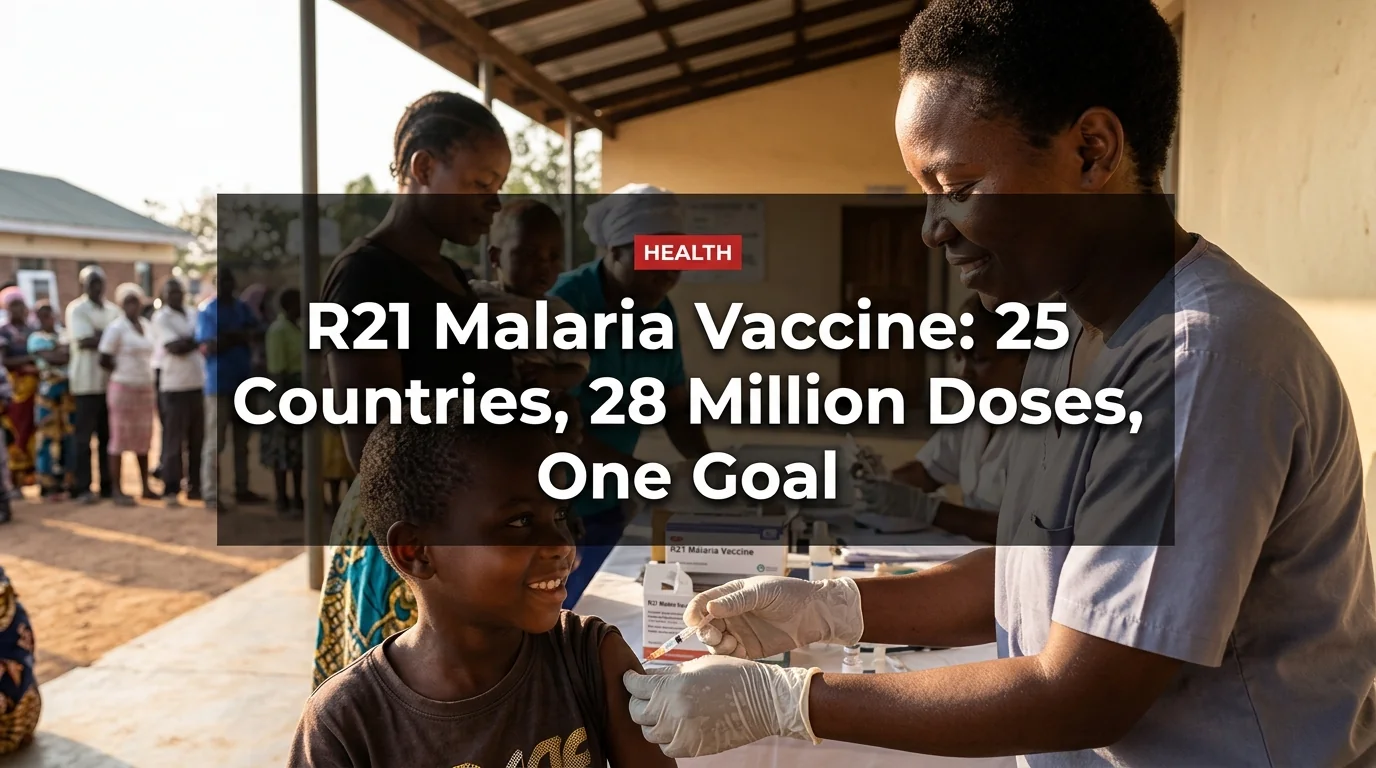
The largest malaria vaccination campaign in history is no longer a plan — it's happening. By early 2026, 25 African countries are administering the R21/Matrix-M vaccine to children, and the first real-world results are arriving. They're better than anyone expected.
- **25 countries** now offering malaria vaccines in routine immunization
- **28 million doses** administered across Africa in 2025
- **50% reduction** in malaria infections recorded in Nigeria's Kebbi State
- **$2.99 per dose** — new pricing deal signed November 2025
- **500,000 child deaths** projected to be prevented by 2035
From Lab to 25 Countries in 18 Months
When the World Health Organization recommended the R21/Matrix-M vaccine in October 2023, skeptics questioned whether supply could match ambition. The first malaria vaccine, RTS,S (Mosquirix), had been bottlenecked for years — only 18 million doses available through 2025, nowhere near enough for a continent where malaria kills over 600,000 people annually.
The R21 story is different. Developed over 30 years by the University of Oxford's Jenner Institute and manufactured by India's Serum Institute — the world's largest vaccine producer — it was built for scale from the start.
Côte d'Ivoire made history on July 15, 2024, as the first nation to administer R21 in a routine immunization program. South Sudan followed the next day. By the end of 2024, Nigeria — which accounts for roughly 27% of global malaria cases — had received its first million doses and launched state-level rollouts.
The Numbers From the Field
The most compelling data is coming from Nigeria's Kebbi State, one of the country's highest-burden regions. Health authorities there reported a 50% reduction in malaria infections at selected health facilities within 10 months of the R21 rollout.
These aren't clinical trial figures under controlled conditions. These are real-world results from one of the most malaria-ravaged regions on Earth, where healthcare infrastructure is stretched thin and transmission is relentless.
Over 200,000 children in Kebbi State alone received their first dose by December 2025. More than 160,000 had already received their second.
R21 vs. RTS,S: Why the Second Vaccine Changed Everything
The existence of two malaria vaccines isn't redundant — it's strategic. Here's how they compare:
| Feature | R21/Matrix-M | RTS,S (Mosquirix) |
|---|---|---|
| Efficacy (seasonal) | 75% | 36% |
| Efficacy (year-round) | 68% | 26% |
| Cost per dose | $2.99 (2026 pricing) | $9–$10 |
| Subsidized cost | ~$0.20 via Gavi | ~$2–3 via Gavi |
| Annual production | 100M+ doses (scaling to 200M) | ~18M doses |
| Dose schedule | 4 doses (3 + booster) | 4 doses (3 + booster) |
| Manufacturer | Serum Institute of India | GSK |
| WHO recommendation | October 2023 | October 2021 |
The cost difference alone is transformative. At $2.99 per dose versus $9–10, the R21 vaccine stretches every health dollar three times further. Gavi's subsidies bring the price paid by the poorest countries down to roughly $0.20 per dose — less than the cost of a bed net.
KEY STAT: Malaria costs Africa an estimated $12 billion in economic losses annually. The R21 rollout is projected to contribute to a $37 billion GDP boost across the continent by 2030.
The People Behind the Push
Professor Adrian Hill, Director of Oxford's Jenner Institute and R21's lead developer, called the rollout "the start of a new era" — a phrase that for once matches the reality. His team spent three decades on the problem.
Adar Poonawalla, CEO of the Serum Institute of India, committed to scaling production to 200 million doses annually by late 2026. The Serum Institute already produces more vaccine doses than any other facility on Earth.
On the ground, leaders like Uganda's Health Minister Dr. Jane Ruth Aceng Ocero have driven rapid deployment. She estimated the vaccine would prevent at least 800 cases of severe malaria among children daily in Uganda alone.
But not everyone is celebrating uncritically. Professor Azra Ghani of Imperial College London cautioned that "neither RTS,S nor R21 is a perfect vaccine" and stressed that bed nets, indoor spraying, and drug treatments must continue alongside vaccination.
What Comes Next
The scale-up is far from finished. Gavi aims to protect an additional 50 million children with full four-dose courses by 2030. The Serum Institute plans to double production capacity. And critically, efforts are underway to bring vaccine manufacturing to Africa itself — with fill-and-finish facilities planned in Ghana (DEK Vaccines) and Nigeria (Biovaccines Nigeria Limited).
The 25 countries currently rolling out malaria vaccines include Benin, Burkina Faso, Cameroon, Central African Republic, Chad, Côte d'Ivoire, DR Congo, Ethiopia, Ghana, Guinea, Guinea-Bissau, Kenya, Liberia, Malawi, Mali, Mozambique, Niger, Nigeria, Sierra Leone, South Sudan, Sudan, Togo, Uganda, and Zambia.
For the first time in six decades of trying, the supply of malaria vaccines finally matches the scale of the problem. The question is no longer whether a malaria vaccine can work. The data from Kebbi State, from Côte d'Ivoire, from Uganda has answered that. The question now is how fast the rest of the world will pay attention.