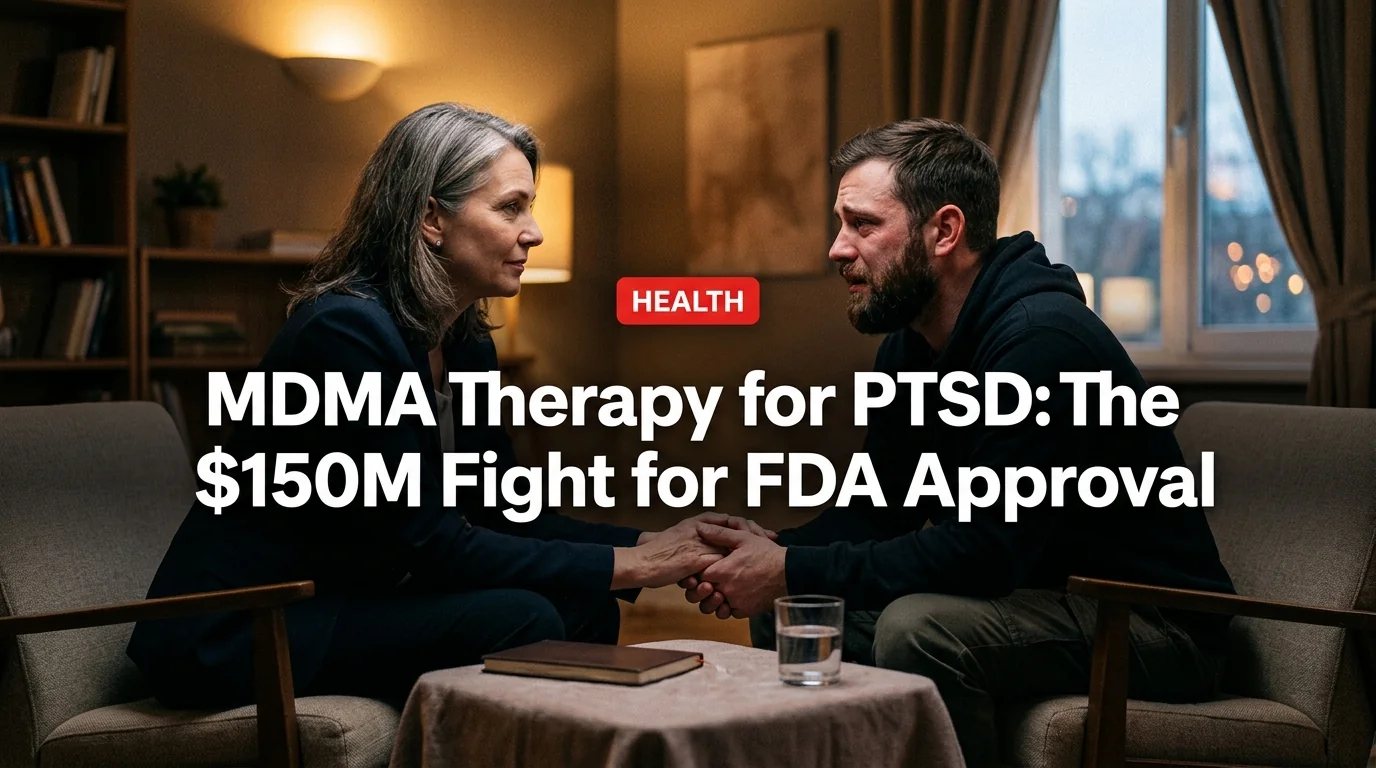
The most controversial drug application in FDA history isn't dead — it's spending $150 million to come back.
Resilient Pharmaceuticals, formerly Lykos Therapeutics, is designing a new Phase 3 clinical trial for MDMA-assisted therapy to treat post-traumatic stress disorder. The company expects to finalize the trial design by mid-2026, with a new drug application unlikely before 2027 or 2028.
This is the story of how a psychedelic compound went from rave drug to breakthrough therapy designation — and why the FDA said "not yet."
The Numbers That Almost Changed Psychiatry
Two Phase 3 trials — MAPP1 (2021) and MAPP2 (2023) — produced results that any drug developer would celebrate. Nearly 9 in 10 participants improved. More than 7 in 10 no longer qualified for a PTSD diagnosis at all.
But the FDA advisory committee saw it differently.
Why the FDA Said No
On June 4, 2024, the Psychopharmacologic Drugs Advisory Committee voted overwhelmingly against recommendation:
| Vote | Yes | No |
|---|---|---|
| Efficacy demonstrated? | 2 | 9 |
| Benefits outweigh risks? | 1 | 10 |
Committee chair Rajesh Narendran, M.D. called the results "largely meaningless" without accounting for expectation bias. The core problem: functional unblinding. Participants could easily tell whether they received MDMA or a placebo, potentially inflating the therapy's apparent effectiveness.
The committee also flagged a documented case of sexual misconduct by a therapist during a Phase 2 trial in 2015, and alleged gaps in reporting adverse events including suicidal ideation.
On August 9, 2024, the FDA issued a Complete Response Letter — a formal rejection — requesting an entirely new Phase 3 trial.
The Corporate Implosion and Rebuild
The rejection triggered a corporate meltdown. Within a week, Lykos Therapeutics slashed three-quarters of its staff. CEO Amy Emerson departed a month later, calling the decision "deeply disappointing" and arguing that existing data should have been sufficient.
What followed was a hostile-takeover-meets-rescue-mission. Antonio Gracias, the billionaire behind Valor Equity Partners, and hedge fund manager Sir Christopher Hohn poured $50 million into the company through a Series B recapitalization. By May 2025, they had installed a new CEO — Mike Burke — and a new chief medical officer, Dr. Javier Muniz.
The August 2025 rebrand to Resilient Pharmaceuticals was more than cosmetic. It signaled a clean break from the controversies that plagued the Lykos era.
The Regulatory Collision No One Prepared For
- The FDA regulates drugs but **not psychotherapy** — MDMA-assisted therapy is both
- No PTSD drug has been approved since **sertraline (Zoloft) and paroxetine (Paxil)** in the early 2000s
- The FDA has started a **pilot program to publicly release Complete Response Letters** — triggered directly by this case
- Over **80 members of Congress** lobbied the White House for approval, citing the veteran suicide crisis
The fundamental challenge was unprecedented: MDMA-assisted therapy isn't just a pill. It's a drug administered within a structured psychotherapy protocol — typically two to three 8-hour sessions with trained therapists. The FDA has a framework for approving drugs. It has no framework for approving drug-plus-therapy combinations where the therapy itself may be driving the results.
This is what committee members meant by "functional unblinding." If participants know they received MDMA (because the effects are unmistakable), and if they then engage more deeply with therapy as a result, is the drug working — or is it the enhanced therapeutic engagement?
The FDA couldn't answer that question with the existing data. So it asked for a new trial designed to isolate the drug's contribution.
The Money Behind the Mission
| Funding Round | Date | Amount |
|---|---|---|
| MAPS nonprofit research (30+ years) | 1986–2023 | ~$165M+ |
| Series A | January 2024 | $100M |
| Series B (recapitalization) | May 2025 | $50M |
| Total raised | — | ~$315M |
Resilient Pharmaceuticals has enough runway to design and begin a new Phase 3 trial, but conducting and completing it will require additional capital. The company's backers are betting that the clinical signal — 71% remission versus 48% on placebo — is real enough to survive a more rigorous trial design.
What Comes Next
Resilient Pharmaceuticals is in active discussions with the FDA about the new trial's requirements. The key questions:
- How to handle blinding: Can an active placebo (a drug with noticeable effects but no therapeutic benefit) reduce the unblinding problem?
- How to standardize therapy: Can the psychotherapy component be controlled enough to satisfy regulators?
- How to address safety: New protocols for therapist oversight, adverse event reporting, and abuse potential monitoring.
If the trial design is finalized by mid-2026 as expected, enrollment could begin late 2026 or early 2027. Results would follow 12 to 18 months later, with a new NDA submission possible in 2028.
For the estimated 13 million Americans living with PTSD — many of them veterans who have exhausted existing treatments — that timeline feels painfully long. But the FDA's insistence on rigorous evidence may ultimately produce something more valuable than a fast approval: a result that no one can credibly dispute.
KEY STAT: If Resilient's new trial confirms the original findings, MDMA-assisted therapy would become the first psychedelic medicine ever approved by the FDA — and the first new PTSD treatment in over two decades.
This article is based on regulatory filings, published clinical trial data from Nature Medicine, and reporting from BioSpace, Psychedelic Alpha, Fierce Biotech, Clinical Trials Arena, and BioPharma Dive.