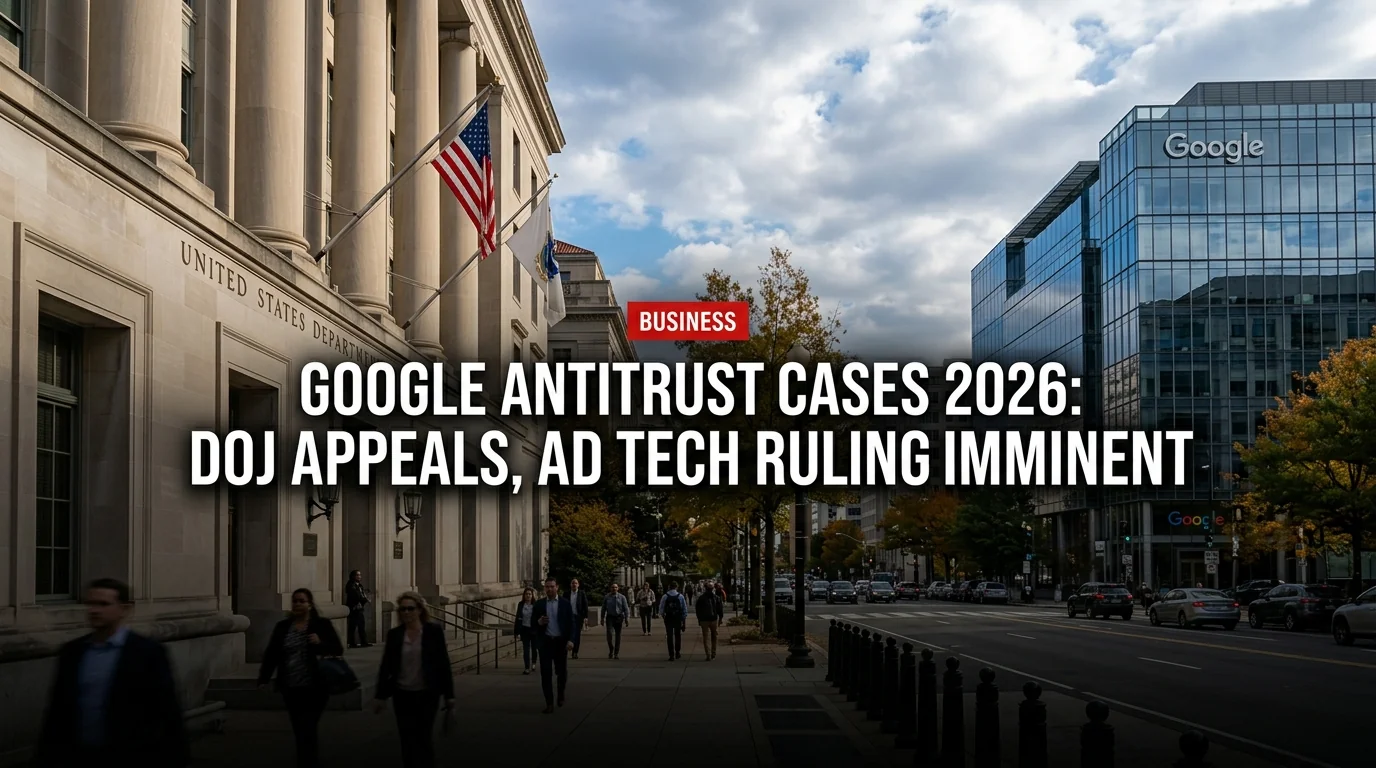
Two federal antitrust cases are closing in on Google from opposite directions — and March 2026 could be the month that reshapes the $2 trillion company forever.
The U.S. Department of Justice is appealing a judge's refusal to break up Google's search monopoly, while a separate federal judge is days away from ruling on whether to force Google to sell its advertising technology business. Together, these cases represent the most aggressive antitrust action against a tech company since the government went after Microsoft in 1998.
Two Cases, One Target
Google is fighting simultaneous antitrust battles in two different federal courts, each targeting a different piece of its empire:
| Search Case | Ad Tech Case | |
|---|---|---|
| Filed | October 2020 | January 2023 |
| Judge | Amit Mehta (D.C.) | Leonie Brinkema (Virginia) |
| Monopoly Ruling | August 2024 | April 2025 |
| What DOJ Wants | Sell Chrome & Android | Sell AdX & DoubleClick |
| Current Status | DOJ appealing | Remedies ruling imminent |
- Google holds **90%** of the U.S. search market
- The company paid **$26.3 billion** in 2021 alone to maintain default search status on devices
- Ad tech accounts for nearly **$200 billion** in annual Alphabet revenue
- Google shares rose **56%** between September 2025 and January 2026 after the initial breakup was denied
The Search Case: DOJ Won't Accept "No"
Judge Amit Mehta ruled in August 2024 that Google illegally maintained its search monopoly — primarily through massive payments to Apple, Samsung, and other device makers to keep Google as the default search engine.
But when it came time for punishment in September 2025, Judge Mehta pulled his punch. He banned exclusive default deals and ordered Google to share search data with competitors, but he refused the DOJ's demand to force Google to sell Chrome and Android.
The DOJ wasn't satisfied. On February 4, 2026, the department and a coalition of states formally appealed, arguing that behavioral remedies amount to a slap on the wrist for a "recidivist monopolist."
KEY STAT: Google paid Apple alone an estimated $20 billion in 2022 to remain the default search engine on iPhones — a deal now banned under the remedies order.
Google has filed its own counter-appeal, challenging the foundational August 2024 ruling that it's a monopolist at all.
The Ad Tech Case: Breakup Ruling Any Day Now
The second case may prove more consequential. Judge Leonie Brinkema found in April 2025 that Google monopolized two critical markets: publisher ad servers and ad exchanges. The DOJ wants Google to sell its ad exchange (AdX) and potentially its publisher ad server (DFP).
The remedies trial concluded in November 2025. Judge Brinkema is expected to issue her ruling before the end of Q1 2026 — meaning it could land any day.
During closing arguments, Brinkema raised practical concerns about a forced sale — particularly that no buyer for AdX has been identified and any acquisition would face its own regulatory review. But legal experts who followed the proceedings believe she is more likely than not to side with the DOJ on structural remedies.
What Google Stands to Lose
The financial stakes are enormous. Ad technology generates the bulk of Google's revenue, and a forced divestiture would fundamentally alter the digital advertising ecosystem.
Google's defense has been consistent across both cases: its products win because they're better, not because of anticompetitive behavior. Lee-Anne Mulholland, Google's VP of Regulatory Affairs, has warned that "radical proposals risk hurting consumers, businesses, and developers."
Critics including DuckDuckGo and Yelp counter that the behavioral remedies in the search case were inadequate and that only structural separation — actually breaking up the company — can restore meaningful competition.
The Road to the Supreme Court
Neither case will end with the current round of rulings. Legal experts predict both the search and ad tech cases will ultimately reach the U.S. Supreme Court, likely in 2027 or 2028.
The D.C. Circuit Court of Appeals will hear the DOJ's search breakup demand, with a decision expected by late 2026. If Judge Brinkema orders a breakup in the ad tech case, Google will immediately seek a stay pending appeal.
The parallel proceedings create an unusual dynamic. If one court orders structural remedies and another doesn't, the resulting legal patchwork could take years to resolve — keeping Google's future uncertain well into the next presidential administration.
Who's Driving the Cases
| Person | Role |
|---|---|
| Pamela Bondi | U.S. Attorney General, leads DOJ prosecution |
| Abigail Slater | Assistant AG, Antitrust Division |
| Sundar Pichai | Alphabet/Google CEO, testified in both trials |
| Karen Dunn | Google's lead trial attorney (ad tech case) |
| Judge Amit Mehta | D.C. District, search case |
| Judge Leonie Brinkema | E.D. Virginia, ad tech case |
What happens next depends largely on Judge Brinkema. Her ruling — expected within days — will signal whether the federal judiciary is willing to go where Judge Mehta wouldn't: ordering the breakup of one of the most powerful companies in history.